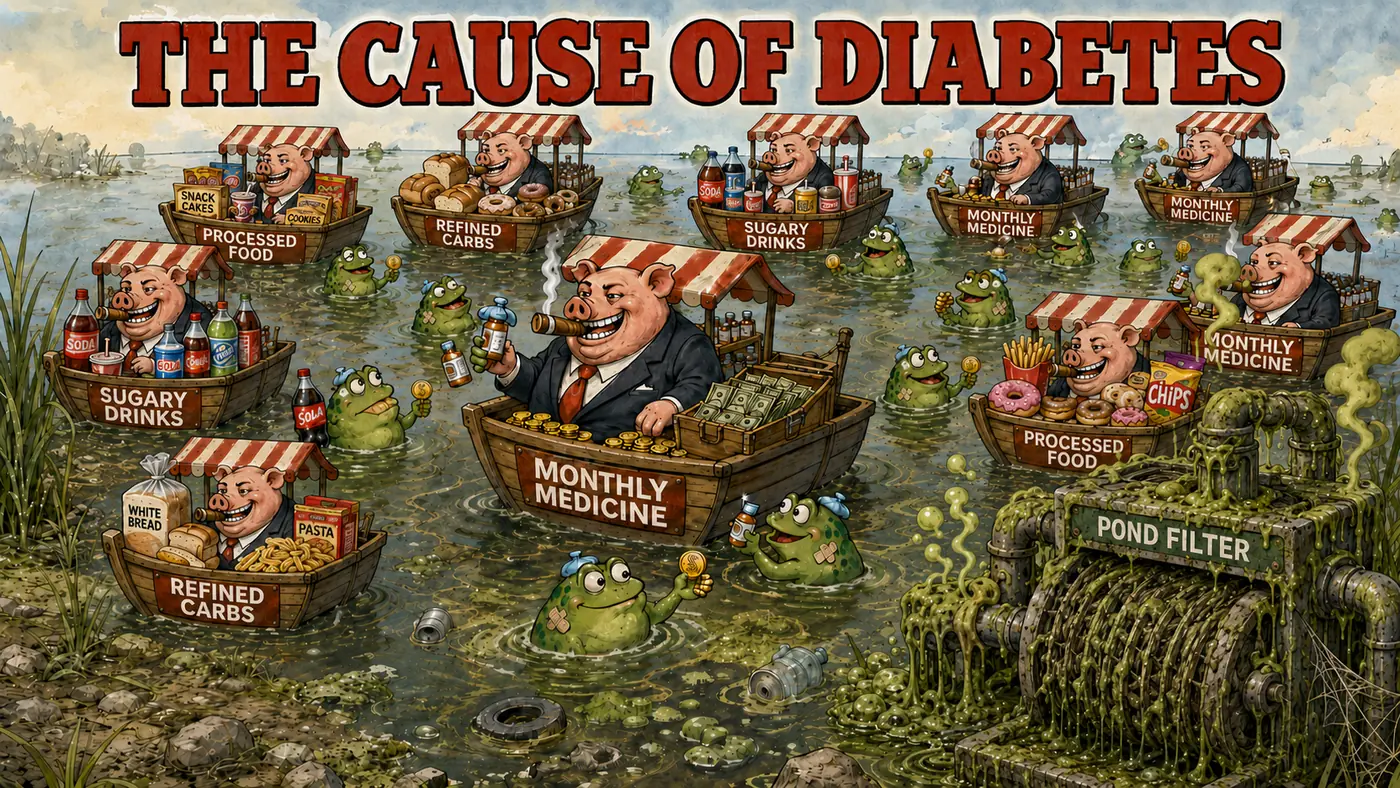
Type 2 diabetes makes an extraordinary amount of money. Food and beverage companies earn money selling products designed to be cheap, convenient and repeatedly consumed. Pharmaceutical, medical-device and healthcare companies earn money treating the chronic illness that can follow.
These industries do not need to cooperate. Nobody needs to sit in a secret room and decide that more people should become diabetic. Each business simply follows the incentives in front of it.
Food companies are rewarded for selling more. Healthcare businesses are paid when more care is delivered. The patient, the family, employers, insurers and taxpayers absorb most of the human and financial cost.
One industry helps pollute the pond. Another treats the frogs. The filter remains neglected because prevention is harder to turn into dependable, recurring revenue.
Nobody Has to Plan an Epidemic
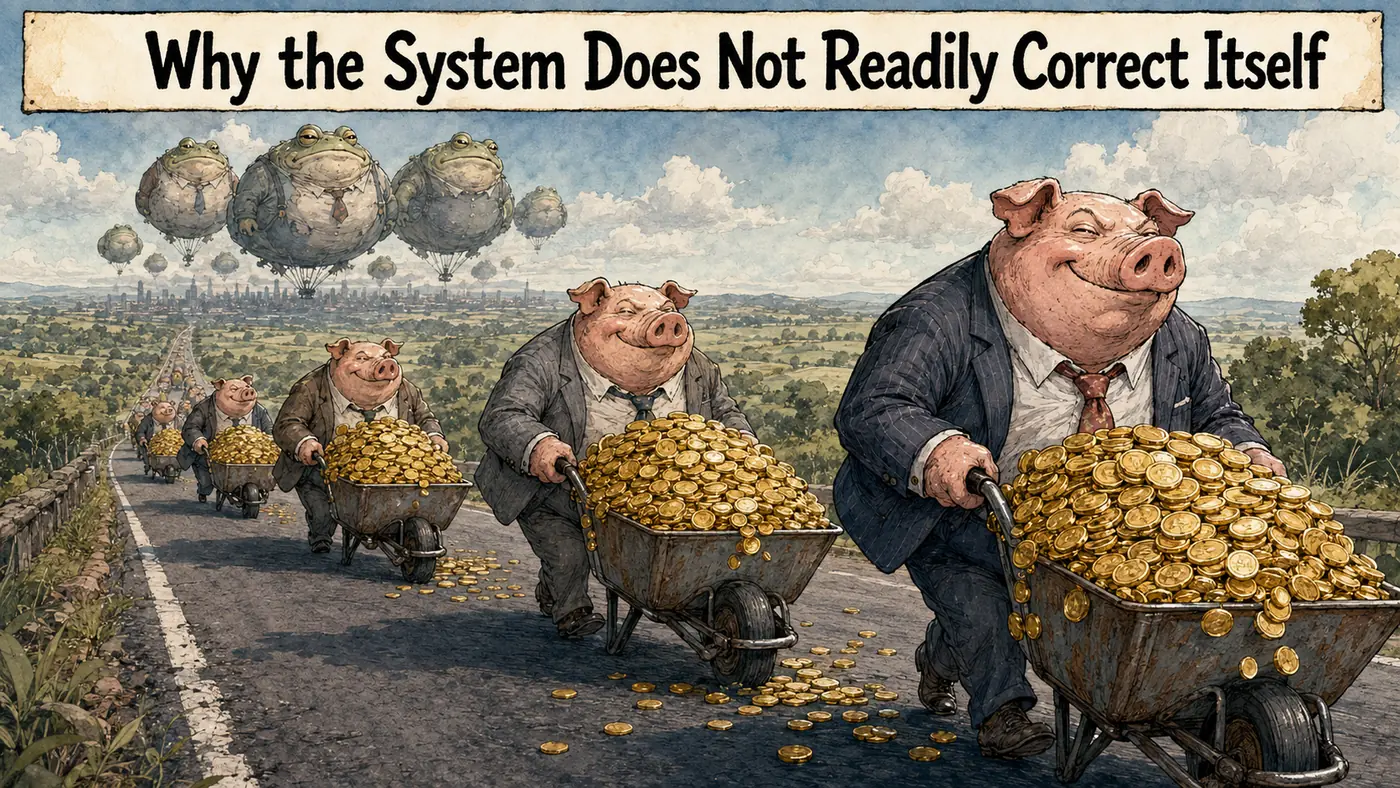
Imagine two executives running competing food companies. One decides not to use every legal way of increasing sales because some strategies may worsen long-term health. The other increases portion sizes, makes the product harder to resist, advertises more aggressively and captures more shelf space.
The second company is likely to grow faster. Its executives are rewarded. Competitors copy what worked. The more restrained company loses ground.
This can happen even when nobody wants people to become ill. The sale is recorded today. The health damage may not appear for years—and when it does, it appears on somebody else’s medical record and budget.
The reward is immediate
More purchases, higher revenue and greater market share are visible now.
The damage is delayed
Weight gain, insulin resistance and diabetes can emerge years later, away from the company’s accounts.
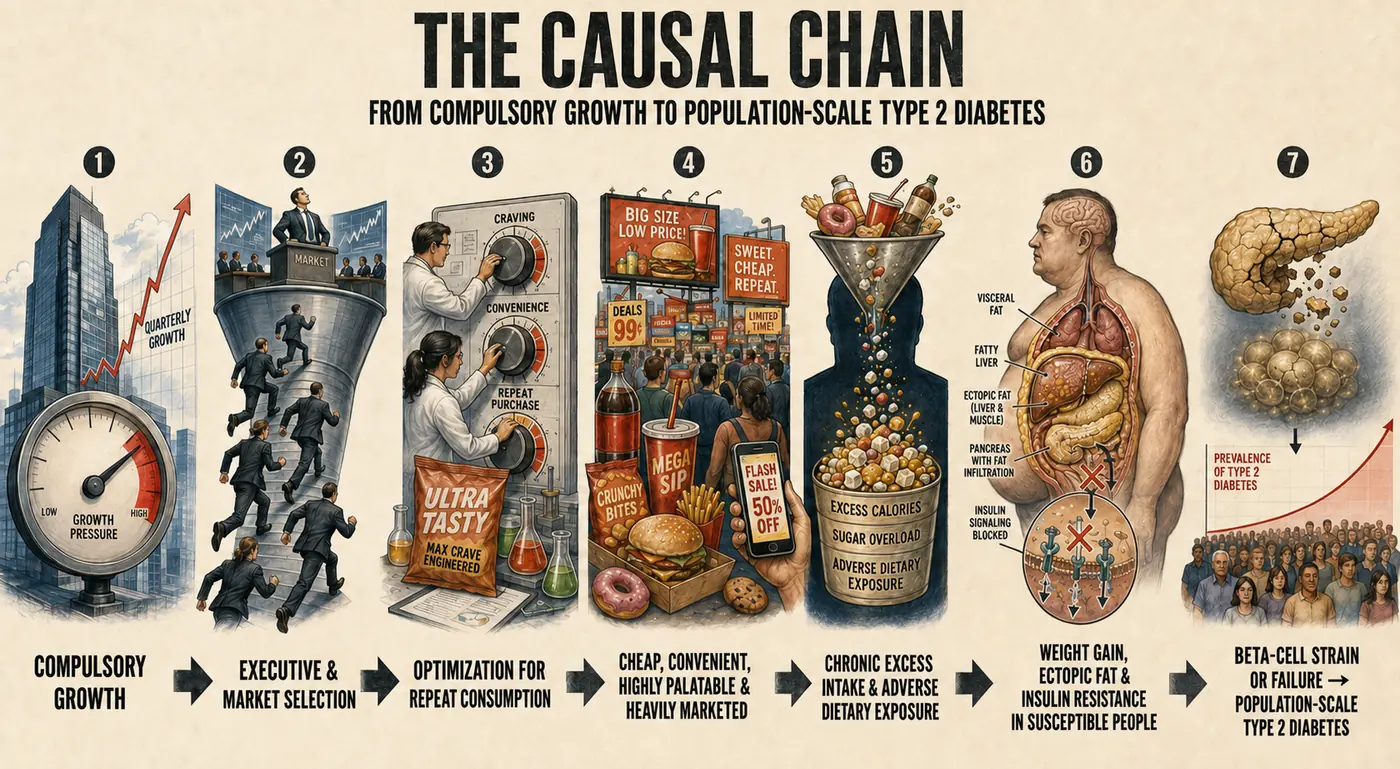
The result is a kind of commercial evolution: products and tactics that generate the most repeat consumption tend to spread. Restraint has to compete against a system that rewards growth.
The First Industry Profits From the Food
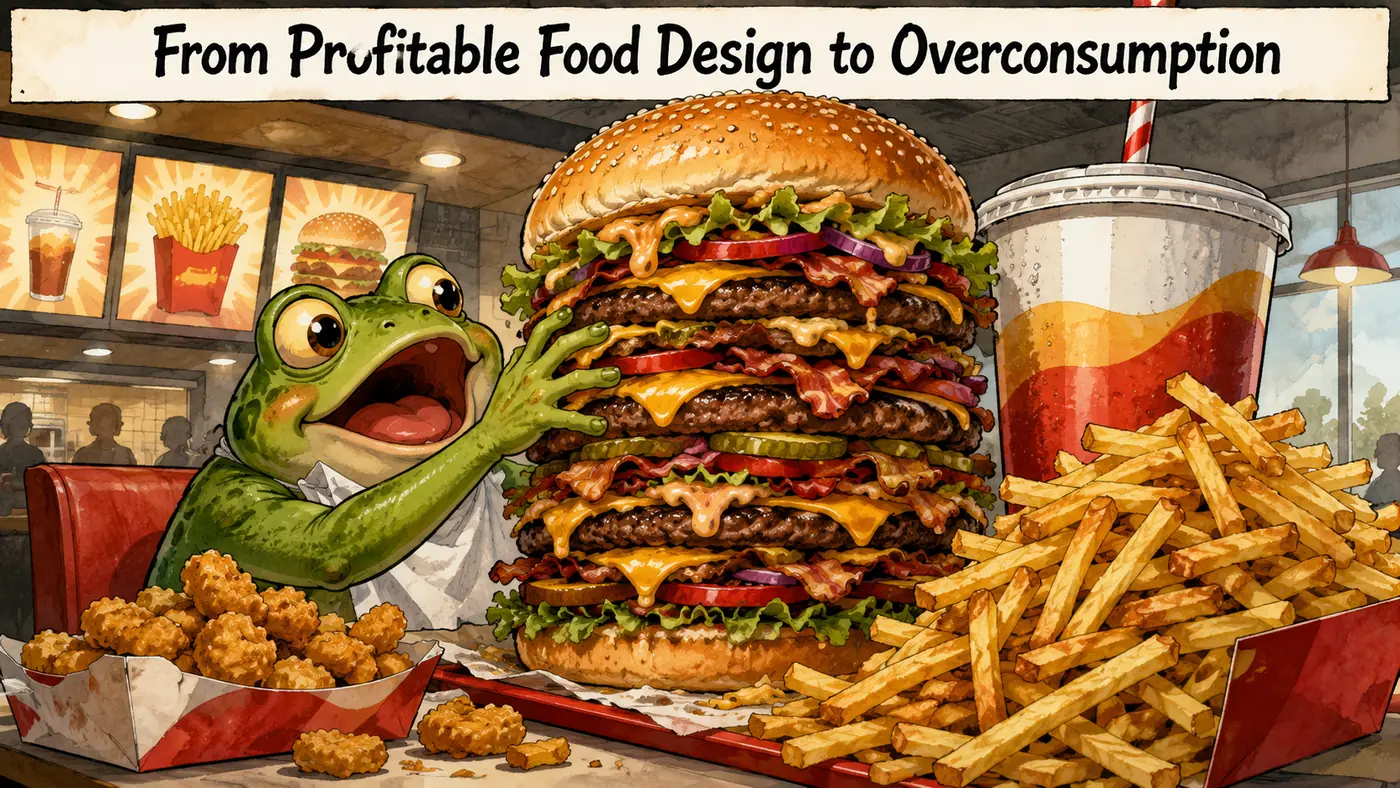
Not all processed food is harmful. Freezing, canning and fortification can be useful. Whole grains are not the same as sugary drinks. The argument is narrower: the commercial system gives a powerful advantage to products that are cheap to make, easy to distribute, heavily marketed and effective at encouraging repeat consumption.
There is direct experimental evidence that the form of food can affect how much people eat. In a controlled National Institutes of Health study, 20 adults were offered either ultra-processed or unprocessed diets. The diets were designed to look nutritionally similar on paper. On the ultra-processed diet, participants ate about 508 extra calories a day and gained about 0.9 kilograms—roughly two pounds—in two weeks. On the unprocessed diet, they lost about the same amount.
extra calories per day on the ultra-processed diet in a controlled inpatient trial.
Source: Hall et al., Cell Metabolism (2019). The study was small and short, but its controlled design makes the direction of the effect unusually informative.
Larger long-term studies cannot prove cause as neatly, but they point in the same direction. A 2023 analysis combining three large US studies with a meta-analysis—a statistical method that combines results from multiple studies found that each 10% increase in ultra-processed food intake was associated with a 12% higher risk of type 2 diabetes. Importantly, some categories were not associated with higher risk. The label is not a verdict on every packaged product.
Source: Chen et al., Diabetes Care (2023).
Then Biology Catches Up
Inside the body, the pathway is well established. It does not happen identically to everyone, and genes matter. But in susceptible people, the simplified sequence looks like this:
- Repeated excess intake adds pressure. The body receives more energy than it can use safely.
- Fat accumulates in harmful places. This can include the liver and pancreas, even in some people who do not look obese.
- The body becomes less responsive to insulin. The pancreas must produce more insulin to keep blood sugar controlled.
- The pancreas can no longer keep up. Blood sugar rises into the diabetic range.
This explains how type 2 diabetes develops. It does not fully explain why the conditions that push people down this path became cheap, normal and almost impossible to avoid.
That is the difference between a biological cause and an upstream cause—a condition or system that acts earlier in the causal chain. Insulin resistance, when cells respond less effectively to insulin, is where the disease becomes visible. Corporate decisions help shape the environment that makes insulin resistance common.
The scale is enormous. The Centers for Disease Control and Prevention (CDC), the main U.S. public-health agency for disease surveillance and statistics, estimates that 40.1 million people in the United States have diagnosed or undiagnosed diabetes, while 115.2 million adults have prediabetes—blood glucose above normal but below the diabetes threshold.
Sources: CDC National Diabetes Statistics Report and the National Institute of Diabetes and Digestive and Kidney Diseases (NIDDK), the U.S. research institute specializing in these conditions: type 2 diabetes overview.

The Second Industry Profits From the Disease
Once a person develops diabetes, treatment is essential. Medicines, glucose monitors, testing, clinical care and hospital treatment can prevent complications and save lives. This article is not an argument against any of them.
But the economics are uncomfortable. Type 2 diabetes is usually a chronic condition. That creates long-lasting demand for products and services. The patient may need prescriptions, supplies, appointments and monitoring for decades.
Diabetes is profitable at both ends of the chain. Revenue can be earned from products that increase the risk and again from managing the illness that follows. The companies need not share a plan or even know one another. Their incentives merely point in compatible directions.
Prevention has a different business model. A healthier food environment, better sleep, daily movement and modest sustained weight loss may prevent years of treatment—but much of that value goes to the person and society, not to a single company that can reliably bill for it every month.
We know prevention can work. In the US Diabetes Prevention Program, an intensive lifestyle intervention reduced the incidence of diabetes by 58% relative to placebo over an average of 2.8 years among high-risk participants. Metformin reduced it by 31%.
Source: Diabetes Prevention Program Research Group, New England Journal of Medicine (2002). These are relative reductions within a high-risk study population, not reductions in everyone’s absolute lifetime risk.
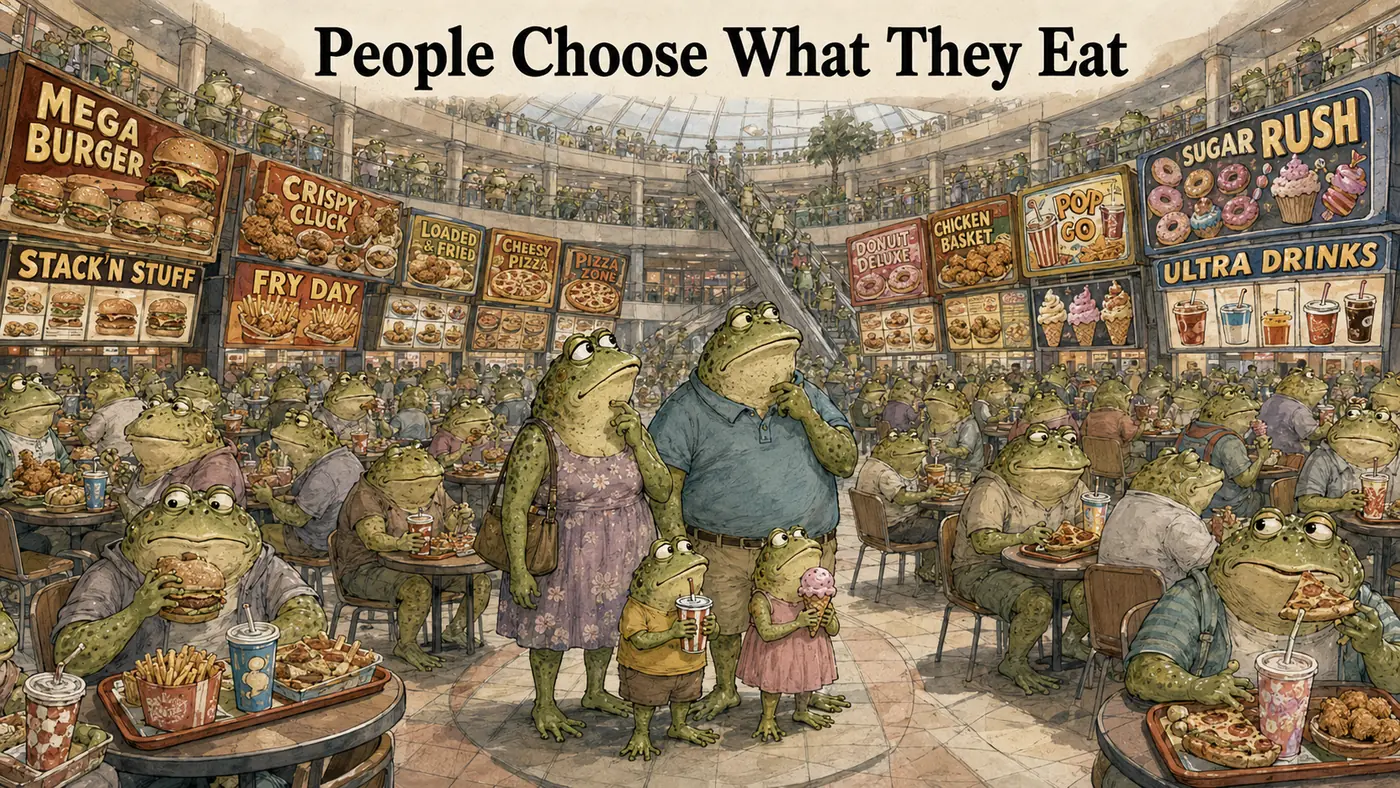
But People Choose What They Eat—Don’t They?
Yes. Personal choices matter. A person can reduce risk by changing diet, activity and weight. Pretending otherwise would be both false and unhelpful.
But “people choose” is not the end of the causal story. Companies spend billions because advertising, placement, packaging, pricing, portion size, convenience and repetition change what people choose. If these techniques did not work, companies would stop paying for them.
A child does not design the supermarket, choose which products are sold beside the checkout or decide what appears in thousands of advertisements. An exhausted parent choosing between a cheap ready meal and a more expensive meal requiring preparation is making a real choice—but not under neutral conditions.
The World Health Organization calls these forces the commercial determinants of health: decisions about product design, pricing, marketing, supply chains and lobbying that shape health on a population scale.
The frogs technically choose what to buy. But the pigs control nearly every sign around the pond.
The Strongest Objections
A serious argument should survive its strongest criticism. Open any objection below.
“Diabetes is mostly genetic.”
Genes help explain why one person develops diabetes sooner than another under similar conditions. They do not explain why a relatively stable gene pool developed diabetes at far greater scale after the environment changed. Genes explain susceptibility; they do not fully explain the epidemic.
“Association is not causation.”
Correct—and no single observational study proves this argument. The case comes from different kinds of evidence pointing in the same direction: controlled food trials, long-term studies, randomized prevention trials, established biology, population data and direct evidence that commercial decisions shape products, preferences and policy. The structural conclusion is an inference from that complete chain.
“Diabetes existed before modern corporations.”
It did. The claim is not that corporations invented type 2 diabetes. It is that modern commercial systems helped transform an existing biological possibility into a mass epidemic.
“Not all corporations—or processed foods—are harmful.”
True. Some companies make beneficial products, reformulate or support prevention. Processing can improve safety, affordability and nutrition. A system-level tendency does not require every company or every product to behave the same way.
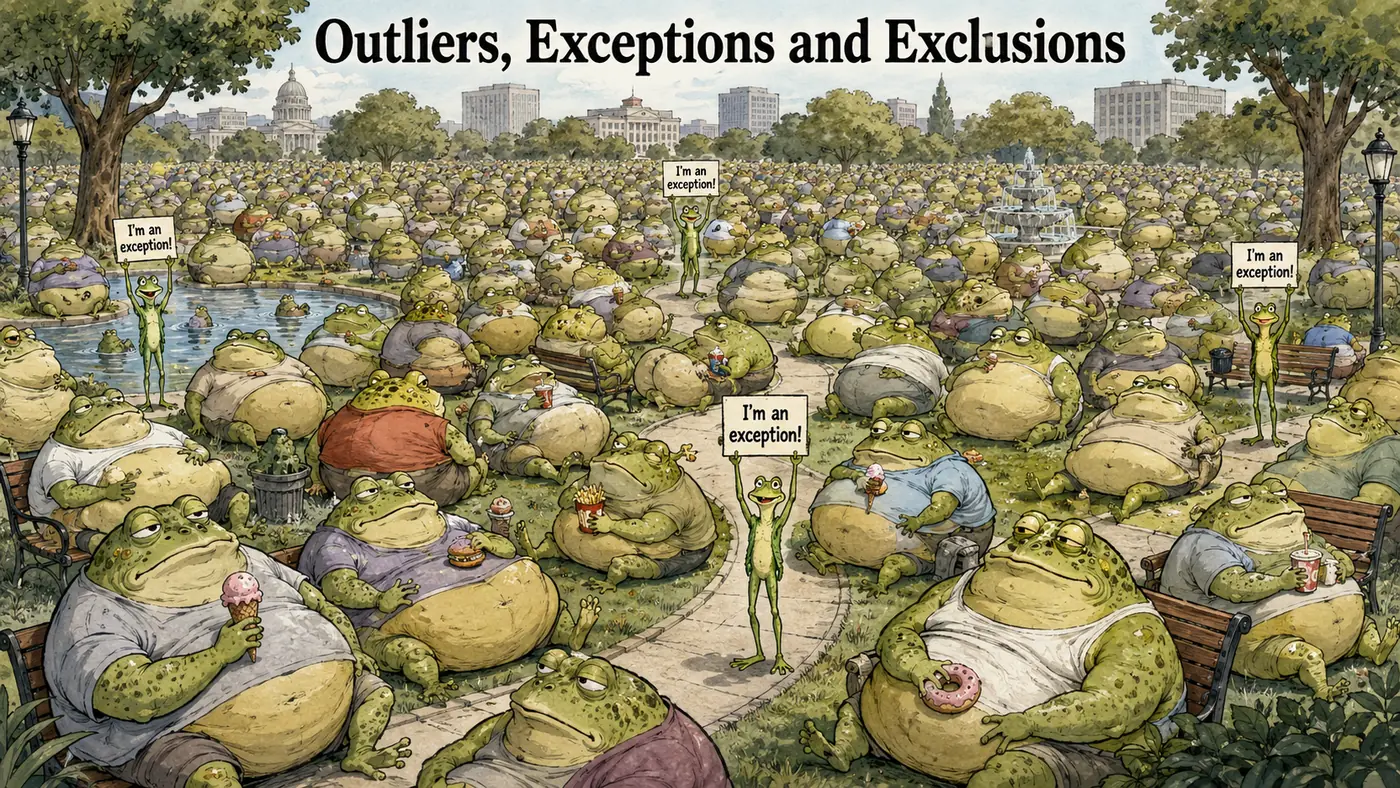
“Some thin, active people still develop type 2 diabetes.”
Also true. Type 2 diabetes has several pathways, and visible body size is not a perfect measure of internal metabolic health. Exceptions prove that this argument cannot explain every case. They do not disprove a population-level cause affecting the majority.
“Does this mean diabetes treatment is bad?”
No. Treatment prevents disability and death. The criticism is not that patients should be denied treatment; it is that the system devotes enormous resources to managing disease while leaving the upstream environment comparatively unchanged.
What the Evidence Proves—and What It Does Not
Well-supported facts
- Food form and formulation can increase calorie intake and weight.
- Diet, weight, activity, genes and insulin resistance materially affect type 2 diabetes risk.
- Intensive lifestyle change can prevent or delay many cases in high-risk people.
- Commercial decisions shape products, prices, marketing and policy.
Reasoned conclusion
- Growth-driven corporate structures are a major upstream cause of the epidemic.
- The same scale and intensity probably would not have developed without those structures.
- No study can assign an exact percentage of all cases to “the corporate system.”

The evidence is strongest for the individual links. The larger conclusion—that corporate structure is itself a cause—is a synthesis. It is not the result of a randomized experiment comparing our world with an otherwise identical non-corporate world. Such an experiment cannot be done.
That uncertainty matters. But it does not make the conclusion arbitrary. Courts, accident investigators and historians routinely identify causes by joining multiple established links into the explanation that best fits the observed result.
How far upstream should we go? Our root-cause thought experiment tests whether corporate incentives are the root cause—or one especially powerful intervention point within a deeper system of biology, technology, culture and institutions.
The Verdict
Diabetes is profitable because the current system rewards selling more cheap, convenient and repeatedly consumed food while sending much of the metabolic cost elsewhere. It then creates additional recurring markets for managing the chronic illness that follows.
This does not mean every corporation behaves badly, every patient followed the same path or anyone planned the epidemic. It means the system repeatedly rewards the conditions that produce more disease—and does not reliably reward prevention enough to stop them.
Type 2 diabetes begins in the body. The epidemic begins in the environment. And the modern environment did not build itself. The wider question is whether we can change the incentives that make harmful outcomes profitable.
Core Sources
- CDC — National Diabetes Statistics Report
- NIDDK — Type 2 Diabetes: causes, risk and prevention
- Hall et al. — Ultra-Processed Diets Cause Excess Calorie Intake and Weight Gain
- Chen et al. — Ultra-Processed Food Consumption and Risk of Type 2 Diabetes
- Imamura et al. — Sugar-Sweetened Beverages and Incident Type 2 Diabetes
- Diabetes Prevention Program Research Group — Lifestyle Intervention or Metformin
- World Health Organization — Commercial Determinants of Health
- World Health Organization — Protecting Children from Harmful Food Marketing
The technical report includes the complete argument, qualifications, counterarguments, corporate case studies and 18 core diabetes citations. A separate review of related research explains the five publications most closely aligned with the investigation’s upstream and downstream incentive mechanisms. Readers can also see how humans, GPT and Gemini developed and reviewed this investigation.