The corporation is a selection system.
A large, investor-owned corporation is a structure built to turn invested money into more money.
Inside that structure, people compete for promotions, budgets, authority—and ultimately survival.
The main scoreboard is financial: Did revenue increase? Did profits grow? Did costs fall? Did the share price rise? Did the company outperform its competitors?
Those who repeatedly deliver the required financial results are rewarded, promoted and given greater control. Those who do not are pushed aside or replaced.
The pressure becomes more extreme the higher someone rises. At the executive level, producing revenue, profit and growth is not merely part of the job. In many corporations, it determines whether someone keeps the job.
The corporation does not need to order people to put profit ahead of everything else. It promotes and retains the people who repeatedly prove that they will.
If protecting human wellbeing increases profits, the corporation has a strong reason to protect it.
If harming human wellbeing increases profits—and the consequences fall on customers, families, taxpayers or society—the corporation receives a strong signal to continue.
Financial growth is enforced from inside the corporation. Human wellbeing usually is not.
The corporation exists apart from the people inside it.
A corporation is not simply a large business. It is a separate legal entity created by law.
It can own property, enter contracts, borrow money, employ people, accumulate profits and debts, sue and be sued, and continue existing when its founders, owners and executives leave or die.
The IRS describes a corporation as a legal entity that is “separate and distinct from its owners.” Delaware corporate law gives it perpetual succession and the power to act in its own name.
This separate existence is what people mean when they describe a corporation as a legal person. It does not mean the corporation is human. It means the law recognizes an artificial entity capable of possessing certain rights, responsibilities and property independently of its members.
Shareholders do not directly own the corporation’s factories, bank accounts, patents or products. The corporation owns those assets. Shareholders own shares that give them particular economic and governance rights.
A board oversees the corporation. Executives run it. Employees work for it. Investors supply capital and expect a return.
This structure can combine money from many investors, limit their personal liability and create organizations far larger and longer-lived than an individually owned business.
Scale and separation also allow ownership, decision-making, personal responsibility and human consequences to become widely separated from one another.

Profit decides who remains in control.
Imagine a large company makes a billion dollars in profit this year. Next year, it makes another billion dollars.
To most people, that sounds like a remarkably successful business. But investors may see a company that failed to grow as expected. The company remains enormously profitable while its share price, executive bonuses and leadership credibility come under pressure.
Shareholders expect a financial return. Boards hold executives responsible for delivering it. Revenue, profit, market share and share-price performance become targets, compensation—and conditions of continued employment.
The message travelling through the system is remarkably consistent:
Being profitable is good. Being more profitable than last year—and promising still more growth next year—is better.

Corporate competition happens on the inside.
We often talk about corporations competing against other corporations. But employees also compete for promotion, managers for budgets, departments for resources, and executives for authority, compensation and succession to the highest positions.
Corporations deliberately use targets, performance reviews, bonuses, rankings, promotion and dismissal to distinguish between people who deliver the required results and people who do not.
Different corporations measure performance differently. But in large investor-owned corporations, financial results normally dominate the scoreboard.
- Strategies that produce growth receive more investment.
- Executives who deliver growth receive more money, authority and influence.
- Competitors copy strategies that succeed.
- Executives who refuse profitable opportunities risk being judged less effective.
- The boundary of normal conduct moves toward what produces the strongest measurable results.
This means the corporation does more than encourage particular behavior. It selects the people who remain in control.
The higher you rise, the more brutal the selection becomes.
At lower levels, an employee may be judged primarily by whether they perform a particular job competently. At senior levels, the questions become increasingly financial: Did your division grow? Did you meet the forecast? Did you improve profitability? Why should the board continue trusting you with the corporation?
Senior executives may care deeply about customers, employees, communities and long-term purpose. But they still operate within a structure that can remove them.

Why short-term results become so important.
Corporations can make long-term investments. The problem is not that they are incapable of thinking beyond the next quarter. The problem is that leaders must repeatedly justify long-term decisions within a system that continuously measures short-term performance.
Investors can sell. Analysts can downgrade the company. Competitors can report better results. Boards can lose confidence. Compensation can fall. Activist investors or an acquirer can remove existing management.
The executive who promises that disappointing results today will produce benefits ten years from now may be correct. But that executive must remain in control long enough for those benefits to arrive.
Research makes that pressure visible. In a survey of more than 400 financial executives, 78% said they would sacrifice economic value to produce smoother reported earnings. Fifty-five percent said they would avoid starting a valuable project if it caused the company to miss the current quarter’s earnings target.
Executives can know that a decision damages long-term value and still consider it necessary for surviving short-term expectations.
The structure selects behavior—and then selects people.
Managers first learn which decisions receive approval, investment and praise. They learn which numbers matter and which arguments win budget meetings.
Then the corporation selects people. Those who internalize its priorities rise more easily. Those who repeatedly resist them are less likely to reach positions of lasting authority.
Over time, senior leadership is populated by people who have survived the same financial filter. They may have different personalities, beliefs and moral values. But they share one proven characteristic: they have demonstrated an ability to deliver the results the corporation rewards.
Good people do not neutralize the structure.
Many corporate employees and executives are decent, thoughtful people. The argument does not depend on corporations being filled with unusually greedy or malicious human beings.
A well-intentioned executive still faces financial targets. A compassionate manager still competes for a budget. An ethical product director still has to demonstrate growth. A socially responsible chief executive still answers to a board and investors.
Individuals can resist the pressure. Powerful leaders can sometimes change the culture or persuade investors to accept a longer time horizon.
But the corporation does not need to persuade every person to become ruthless. It can replace people who consistently refuse to produce the required results.
The system does not need bad people. It needs people who will do what survival inside the system requires.

Why harm can remain profitable.
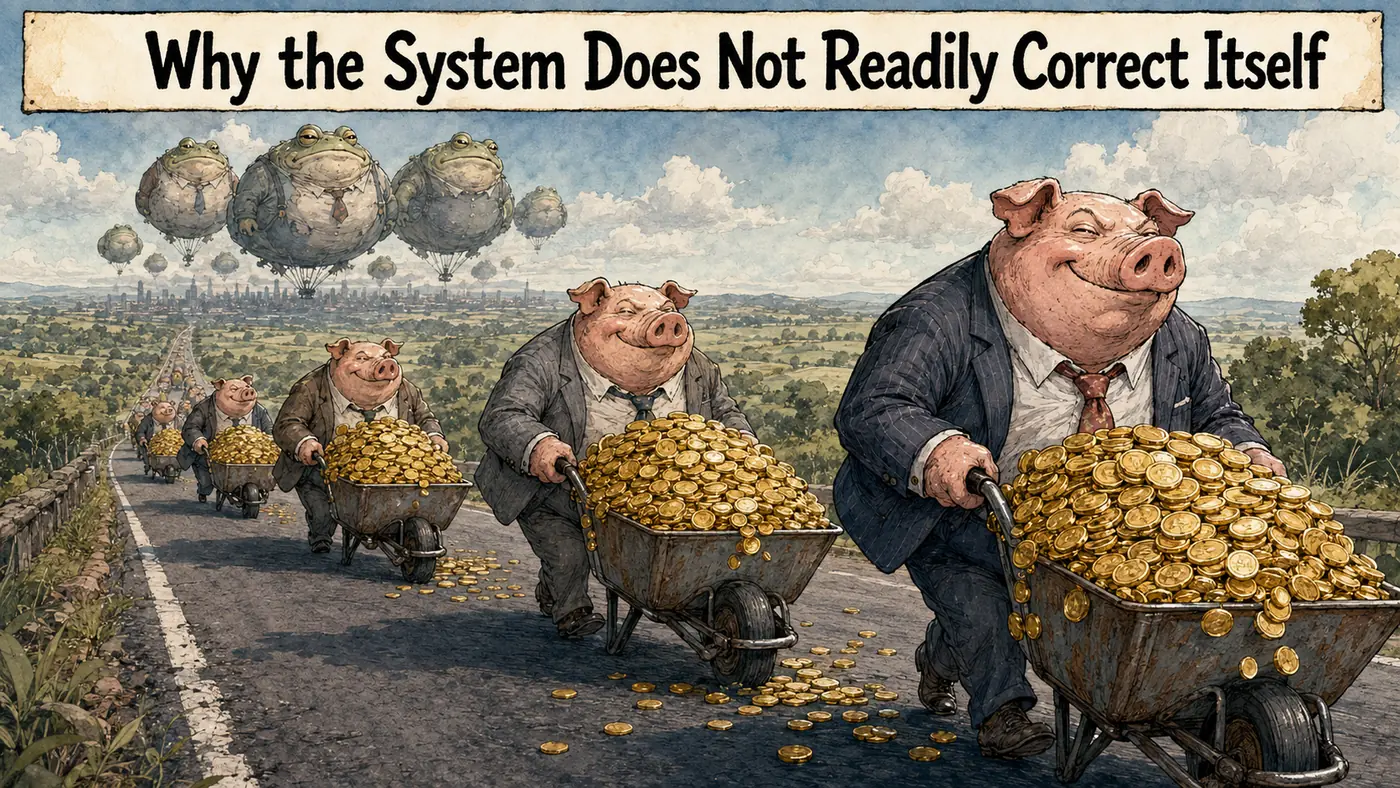
A corporation keeps financial accounts. Revenue, wages, manufacturing costs, taxes, settlements and profit are recorded. Many consequences created by corporate activity are not.
If unhealthy products contribute to diabetes decades later, the medical consequences do not automatically appear as an expense on the food manufacturer’s income statement. If gambling destroys a family’s finances, the loss may appear as revenue for the gambling company. If social media increases anxiety, the anxiety is not deducted from platform revenue.
These are often called externalized costs (opens glossary in a new tab): consequences created by an economic activity but paid substantially by someone outside the corporation.
The corporation receives a strong signal to respond when those consequences reduce sales, create legal liability, damage the brand or trigger regulation. Until then, its internal scoreboard may continue describing the activity as successful.
When profit and wellbeing agree.
The corporate structure does not automatically produce harm. A company can prosper by making safer products, developing better medicine, treating employees well or solving genuine human problems.
The revealing test comes when profit and wellbeing separate. When the strongest financial result also benefits people, the structure works remarkably well. When the strongest financial result harms people—but the harm falls outside the corporation—the same structure can continue rewarding the harmful action.
The important technical qualification.
There is no general law requiring every corporation to increase revenue or maximize this quarter’s share price. Corporate directors ordinarily have substantial discretion to pursue long-term value, protect reputation, treat employees well and reduce risk.
The pressure described here is created by the interaction of investor expectations, valuation, board oversight, executive compensation, competition, access to capital and the ability to leave many human costs outside corporate accounts.
Large investor-owned corporations commonly convert financial expectations into targets, incentives, competition and career consequences that select people and strategies capable of delivering growth.
There is no universal legal command that every corporation must grow continuously, maximize immediate profit or choose short-term revenue over every other consideration.

Delaware—the legal home of many major U.S. corporations—allows corporations to pursue lawful purposes and does not impose a general “must grow” command. Public-benefit corporations can adopt a different mandate that expressly balances financial interests with a stated public benefit.
How the selection pressure reproduces itself.
No participant has to demand harm. Each can make a locally rational decision, and the complete system can still select for more aggressive growth.
Investors provide capital
Shareholders buy ownership expecting a return through dividends, a higher share price, or both.
The board oversees management
Directors select, monitor and can replace executives responsible for the corporation’s performance.
Executives receive targets
Revenue, margin, earnings, market share and shareholder return become plans, bonuses and career consequences.
The company must produce more
Stable profit can be judged inadequate when investors expected growth or competitors are expanding faster.
The winners receive more power
Capital, authority, compensation and prestige flow toward the people and strategies that expand financial returns.
The selection is repeated
Competitors copy what succeeds. Executives who refuse profitable strategies risk missed targets, lost influence or replacement.
Who is accountable to whom?
Shareholders
Shareholders own the residual financial claim. They can benefit through dividends and through capital appreciation when the share price rises.
The board
Shareholders elect directors. The board appoints, evaluates and can replace senior management. Its focus is the corporation and its stockholders—not an independent duty to maximize public welfare.
Executives
Executives answer to the board through budgets, performance reviews, incentive pay and continued employment. The SEC (opens glossary in a new tab) requires public companies to disclose relationships between executive compensation and financial-performance measures.
Capital markets
Analysts, lenders, institutional investors, activist shareholders and potential acquirers compare the corporation with alternatives. Weaker expected growth can reduce valuation and access to capital even while the business remains profitable.
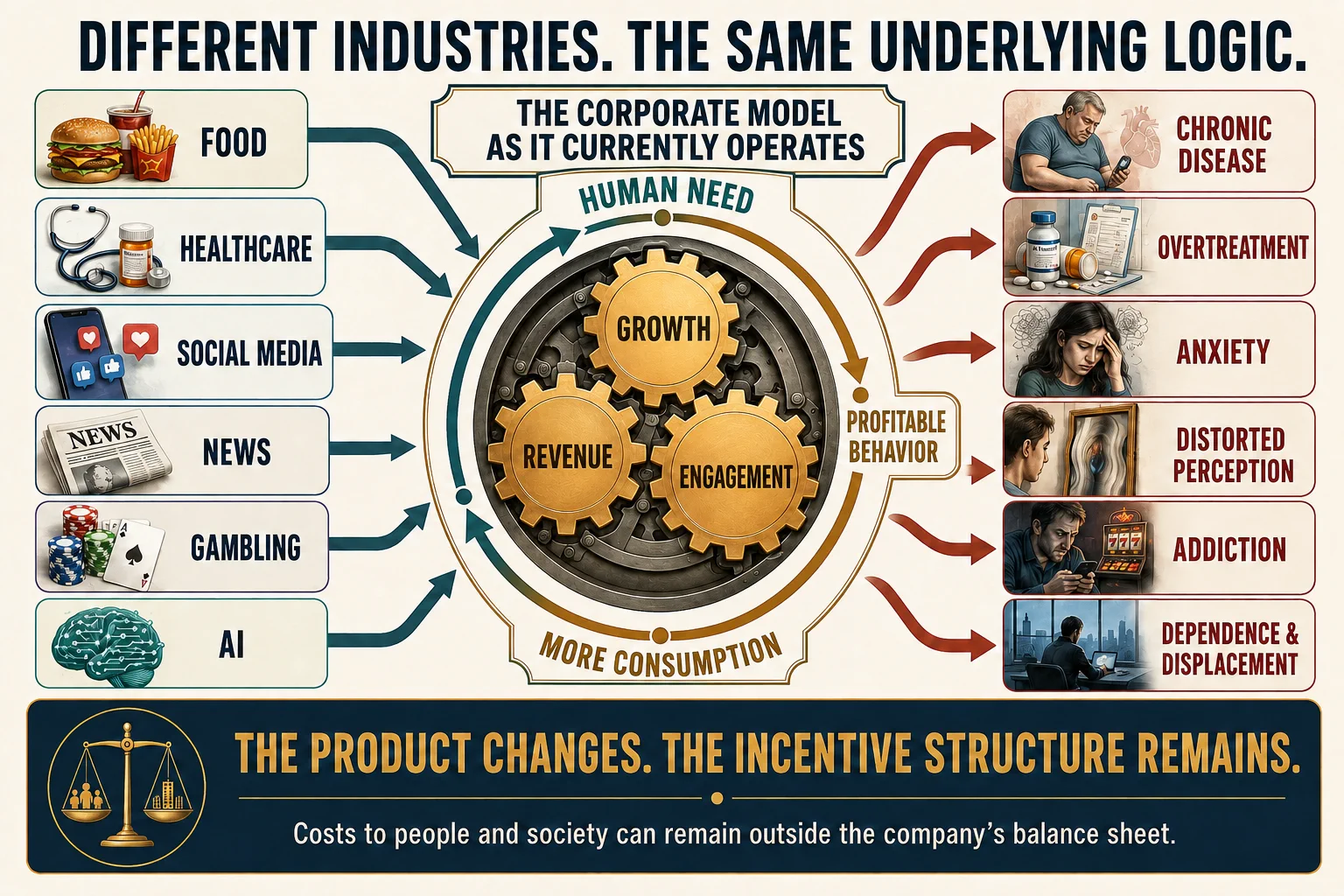
The product changes. The selection process remains.
Food, healthcare, social media, news, gambling and artificial intelligence produce different products and affect different parts of human life. But the same mechanism can operate beneath them:
- Identify a human need, desire, fear or vulnerability.
- Build a product or service around it.
- Measure the behavior that generates revenue.
- Increase that behavior.
- Reward managers who produce the strongest growth.
- Replace managers who do not.
- Treat consequences outside the corporation as someone else’s problem—unless they return as a financial cost.
Why this matters to diabetes.
The modern food environment was not designed by a single villain. It emerged from thousands of companies and millions of decisions.
Within those companies, people were rewarded for increasing sales, reducing costs, extending shelf life, strengthening brands, improving margins and encouraging repeat consumption.
The products that performed best received more investment. The marketing campaigns that generated more sales were repeated. The executives who delivered growth acquired more authority. Companies that failed to compete disappeared, were acquired or replaced.
The revenue appears immediately in corporate accounts. The resulting health consequences may take years to develop—and much of their cost is paid by individuals, families, employers, insurers and taxpayers.
Then the healthcare system creates another profitable market around managing the resulting chronic disease.
One system profits from selling products that help create disease. Another profits from managing the disease after it appears.
This does not require a conspiracy. It requires two systems responding predictably to their financial incentives. The main investigation follows the complete food-to-disease causal chain, while the technical evidence defines what the argument proves—and what it does not.
The important exceptions.
A credible structural claim must not pretend every corporation is identical.
- Dividends can reward shareholders without rapid growth. Mature companies can return profit directly rather than promise continual expansion.
- Private and closely held businesses can choose different objectives. Their owners may accept stable profit, continuity, employee welfare or community value.
- Public-benefit corporations have a different legal mandate. They can expressly balance financial interests with the interests of affected people and a stated public benefit.
- Ordinary corporations can act responsibly. Directors can pursue long-term resilience, reputation, trust and reduced harm.
- The argument concerns selection pressure, not inevitability. Exceptions show alternatives are possible; they do not remove the pressure facing large financialized firms.
The uncomfortable conclusion.
The central problem is not simply that some corporations behave badly. It is that corporate structure continually selects the people, products and strategies that produce financial growth—and gives them greater power.
Those who deliver profit survive. Those who deliver more profit rise. Those who fail to deliver it are replaced.
Human wellbeing influences this process when it affects financial results—or when society forces it into the calculation through law, regulation, liability, organized pressure or a different corporate purpose.
Corporations do not merely reward profit. They use profit to decide who remains in control.
Until we change what the structure measures, rewards and punishes, replacing individual executives will not solve the problem. The system will keep selecting new people to produce the same result.
Primary and supporting sources.
- Internal Revenue Service, Business Types — a corporation as a legal entity separate and distinct from its owners.
- Delaware General Corporation Law §§121–122 — perpetual succession and the corporation’s ability to act, own property and sue in its own name.
- Delaware General Corporation Law §141 — management of corporate affairs under the direction of a board.
- Delaware public-benefit-corporation law — an alternative mandate balancing stockholder interests with stated public benefits.
- Graham, Harvey and Rajgopal, The Economic Implications of Corporate Financial Reporting — evidence that executives may sacrifice long-term value to meet short-term earnings expectations.
- U.S. SEC, Pay Versus Performance — disclosure connecting executive compensation with shareholder return and financial measures.
- Wood et al. (2023), Globalization and Health — financialization, shareholder primacy and ultra-processed-food corporations.