The familiar story places responsibility at the bottom of the system.
Individuals must exercise willpower. Parents must control what children eat. Patients must follow medical advice. Voters must make their voices heard. Consumers must reward good companies and punish bad ones.
Yet much of the power sits somewhere else. Corporations formulate the products, purchase the advertising, influence the rules, shape what is available and profit from the resulting consumption. When chronic disease follows, another group of corporations profits from managing it.
Power is concentrated. Consequences are dispersed. Responsibility is pushed downward.
The questions below do not pretend to be neutral. They identify contradictions that polite language often conceals. The accompanying comments do not claim that every premise has one simple answer. They explain why the question deserves to remain open.
Why are people blamed for lacking willpower when corporations deliberately engineer the food environment to overcome it?
Willpower is treated as though it operates in a vacuum. It does not. Food products are formulated, packaged, priced, positioned and advertised to increase attention, desire, convenience and repeat consumption. The most commercially successful methods are rewarded, copied and refined.
Individuals still make choices. But corporations help construct the conditions under which those choices are made—and possess vastly more information about influencing behavior than any individual consumer possesses about resisting it.
The contradiction: the seller is rewarded for becoming better at stimulating consumption, while the consumer is blamed for failing to resist.

Why are parents blamed for what their children eat while corporations are legally permitted to manipulate those children with sophisticated food marketing?
Parents are told that feeding children well is their responsibility. At the same time, sophisticated businesses can use characters, entertainment, repetition, social influence, product placement and digital targeting to cultivate children’s preferences before those children can understand commercial persuasion.
The corporation employs specialists, research and large budgets. The parent must counter that influence repeatedly—in shops, restaurants, schools, online and in the home—while also managing the rest of family life.
The contradiction: corporations are permitted to create the pressure, while parents are judged by their ability to defeat it.

If the conventional explanation of type 2 diabetes is correct and useful, why has repeating it for decades completely failed to stop the epidemic?
For decades, people have been told that type 2 diabetes involves insulin resistance, excess body fat, poor diet, insufficient activity, genetics and personal risk factors. Much of that is medically correct. Yet an explanation should be judged partly by what it enables us to change.
If the dominant explanation repeatedly leads back to educating and treating individuals while prevalence remains extraordinarily high, perhaps it describes the mechanism inside the person more successfully than the forces producing the pattern across the population.
The contradiction: the explanation is treated as adequate even though the epidemic it is meant to explain persists.

Why do medical authorities call the final biological malfunction the ‘root cause’ while largely ignoring the corporate system that repeatedly causes that malfunction?
Insulin resistance and pancreatic dysfunction help explain how type 2 diabetes develops biologically. But calling the last measurable failure in a causal chain the root cause can stop the investigation precisely where it becomes socially and economically uncomfortable.
What repeatedly produces chronic excess energy intake? What shapes the food environment? What determines formulation, portion size, price, distribution and promotion? Biology answers what happens inside the body. It does not, by itself, explain why the same biological vulnerability is activated across hundreds of millions of bodies.
The contradiction: causation is pursued deeply inside the body but often only shallowly outside it.
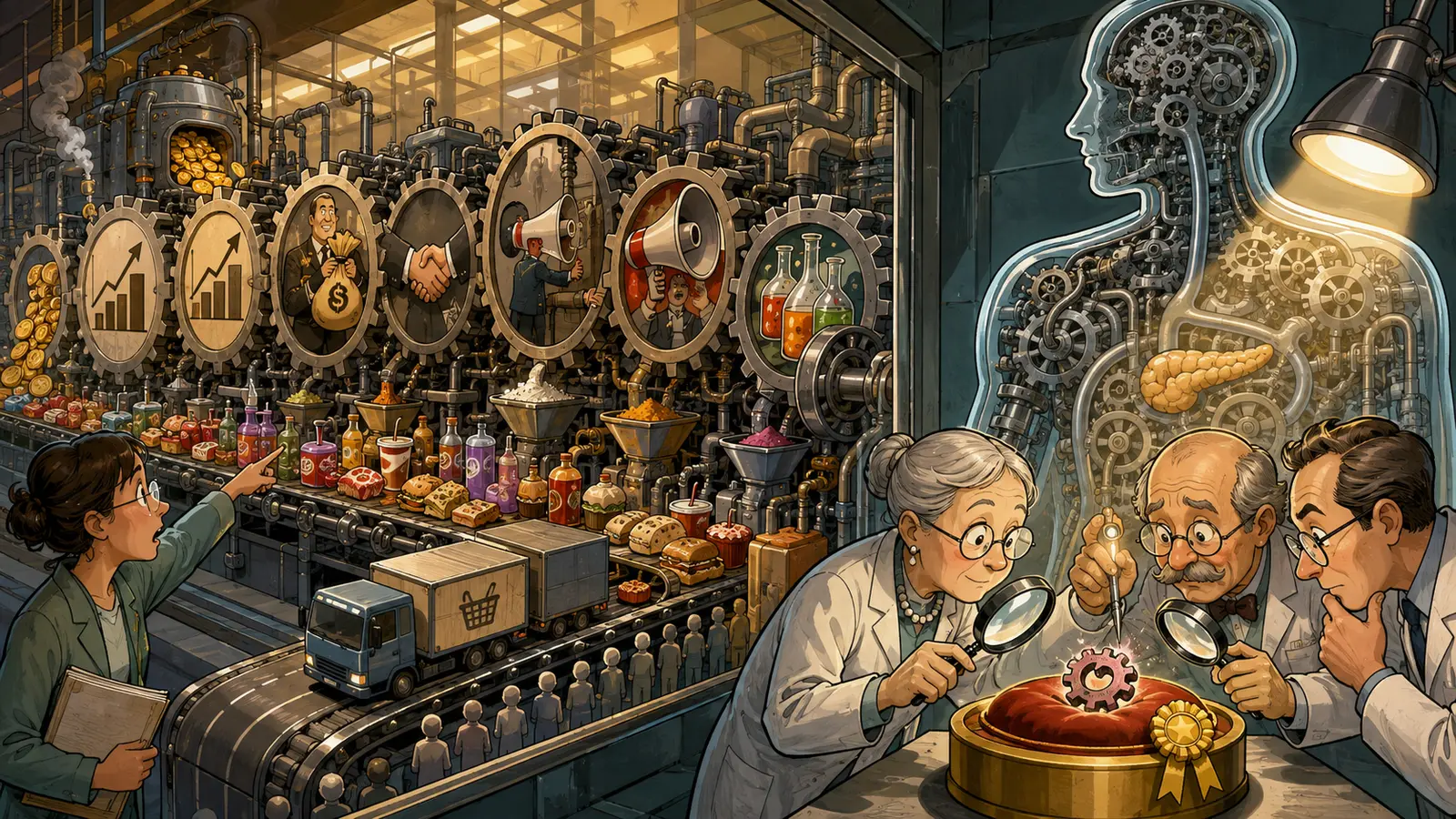
Why are food corporations allowed to influence government dietary guidance that could reduce the sales of their products?
Dietary guidance can affect public understanding, institutional purchasing, school meals, product reputations and ultimately sales. Food companies therefore have a direct financial interest in how evidence is interpreted, which language is adopted and which recommendations become policy.
Industry knowledge can be relevant. Financial interest does not automatically invalidate an argument. But participation is not neutral when the organization participating may gain or lose billions of dollars depending on the result.
The contradiction: the companies whose sales may be constrained by public-health guidance are allowed to help shape that guidance.
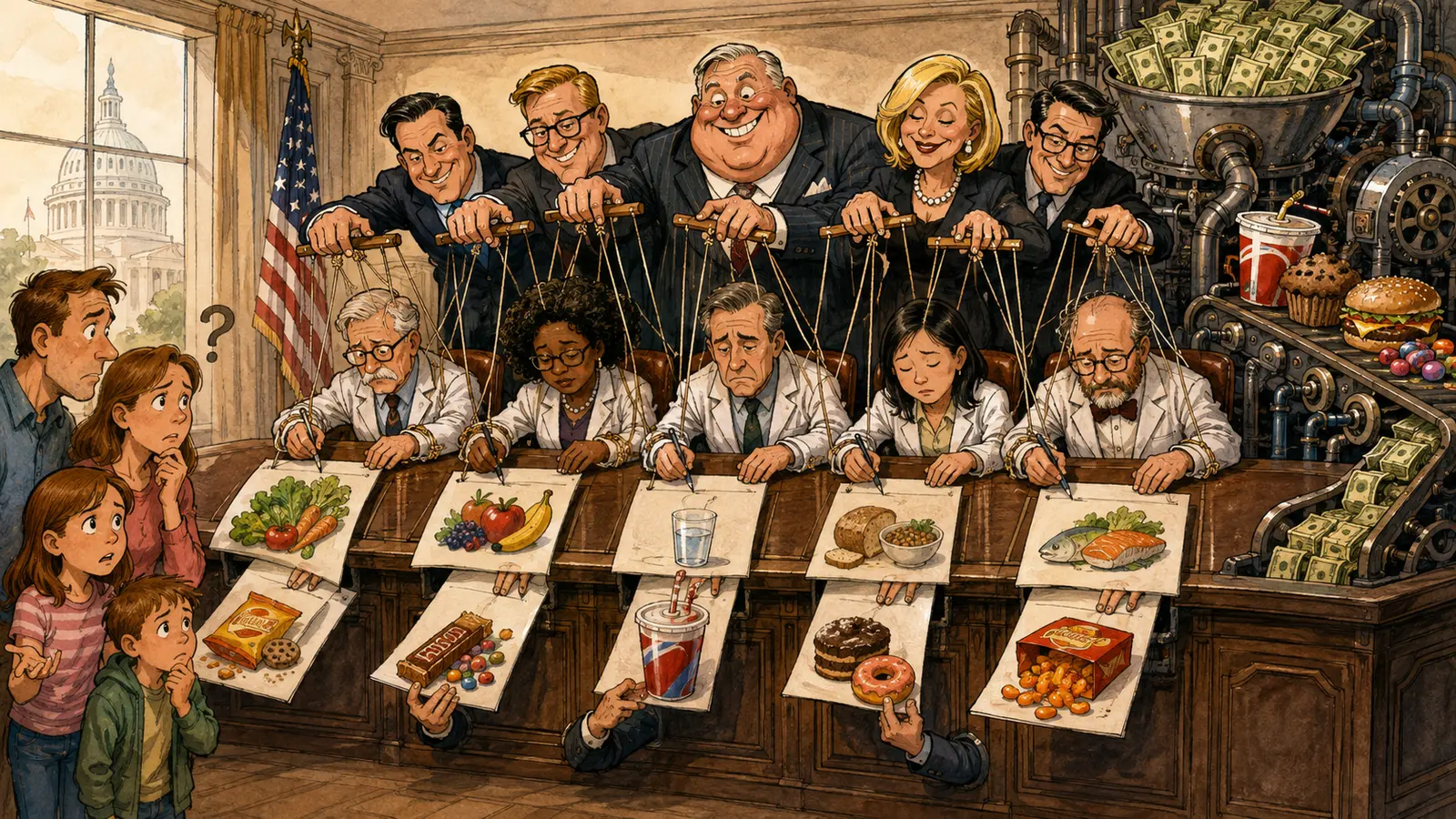
Why can corporations spend millions influencing government decisions while the customers who must live with those decisions have almost no meaningful influence at all?
A corporation can retain lobbyists, support trade associations, commission research, monitor legislation and cultivate relationships with policymakers year after year. Its financial benefit from one favorable rule can justify concentrating enormous resources on influencing that decision.
The costs may be spread across millions of people. Each person bears only a fraction, may never know which decision produced it and has neither the time nor the specialist knowledge to respond. Citizens possess votes; corporations possess continuous organized access.
The contradiction: those who experience the collective consequences have political equality in theory but nothing approaching equality of influence in practice.

Why can one angry customer seriously damage a small business with a Google review while millions of customers have no equivalent way to hold a multinational corporation accountable?
A local business may have one Google profile and a small number of reviews. A single one-star rating can noticeably reduce its score and affect whether prospective customers call. The connection between the complaint and the business is direct, public and difficult to escape.
Criticism of a multinational corporation is fragmented among products, subsidiaries, brands, retailers, individual locations, social platforms and customer-service systems. Large corporations certainly receive criticism, but there is no comparably simple, universal reputation score attached to the corporation as a whole.
The contradiction: digital reputation concentrates accountability on small businesses while dispersing it for organizations with vastly greater social impact.

Why are corporations granted many of the legal rights of people without being expected to accept the moral responsibilities demanded of people?
Corporations can own property, enter contracts, bring legal claims and exercise important legal protections. But a corporation does not feel shame, illness, hunger, pain or mortality. Its formal incentives reward institutional survival, growth and financial performance.
We expect an actual person to consider whether benefiting from harm is morally acceptable. A corporation can answer that each product is legal, each consumer chose freely and each executive fulfilled a professional duty—even when the aggregate outcome is destructive.
The contradiction: corporations receive person-like protections while responsibility dissolves among executives, shareholders, consumers and the law.

How many of the top executives who profit from the diabetes epidemic—from selling the food that helps cause it to selling the drugs used to treat it—are themselves obese or have type 2 diabetes?
We cannot determine the private medical histories of senior executives, and appearance cannot establish obesity or diabetes. The honest answer is that public information probably cannot provide a reliable count.
But the visual contrast remains striking. The public faces of the corporations profiting from the diabetes economy rarely appear to exhibit its most visible consequences. Those executives also possess access to high-quality food, preventive care, flexible working conditions, personal training and expensive treatment that many consumers do not.
The question is not an invitation to diagnose named individuals. It asks whether the people with the greatest power over this system inhabit the same health environment as the people living with its outcomes.
The contradiction: those who profit most from the system may be among those best equipped to escape its consequences.
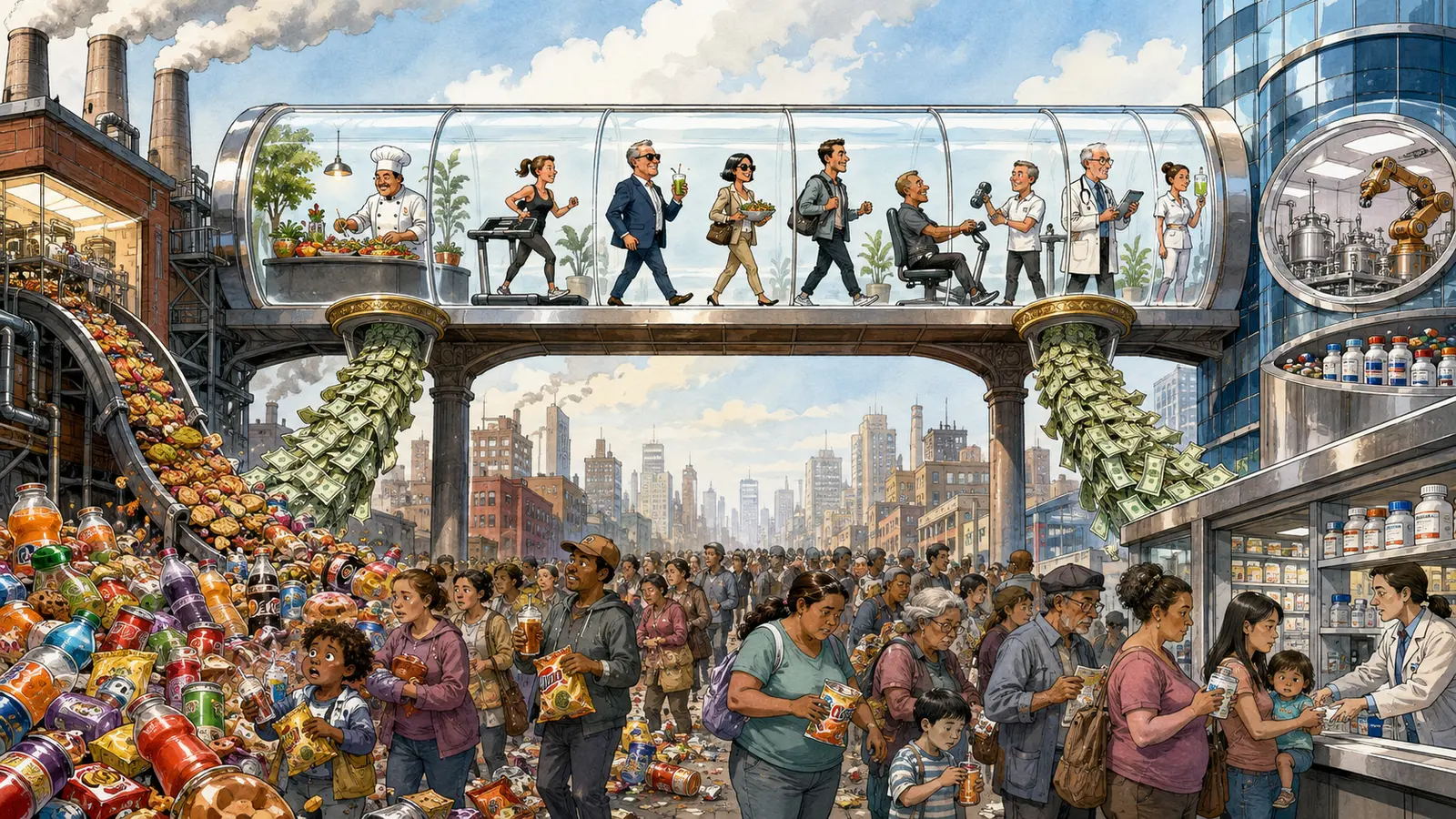
Why are corporations allowed to keep the profits from causing harm when the penalties they eventually pay are often little more than a cost of doing business?
A penalty is supposed to deter the behavior being punished. That can work only if the expected cost of the penalty is greater than the expected benefit of continuing the behavior.
A corporation can compare an eventual penalty with the revenue earned, the profit retained, the probability of being caught, the years before enforcement occurs and the competitive disadvantage it might suffer by behaving differently. Even a penalty that sounds enormous to an individual may leave the underlying conduct profitable.
The real test is not whether a corporation was fined. It is whether the penalty removed the profit, compensated those harmed, changed the incentives, created consequences for the decision-makers and made repetition economically irrational. If it did none of those things, the penalty may function less like punishment and more like an operating expense.
After every penalty has been paid, did the corporation still make money from the conduct?
If the answer is yes, the system may not have punished the harm at all. It may merely have taken a share of the proceeds.
The contradiction: society claims to prohibit harmful corporate behavior while sometimes imposing penalties that leave the behavior profitable.

The pattern behind the questions
Power rises. Responsibility falls.
These ten questions point toward the same structural pattern. Corporations possess unusual power to shape products, preferences, information, regulation and political decisions. Yet responsibility for the resulting health outcomes is assigned primarily to individuals and families.
Perhaps the hardest question is the simplest: why does responsibility remain with the people who possess the least power to change the system?
These questions do not prove the thesis of this website. They explain why the conventional story is not enough—and why the investigation must continue upstream.