Profitable exposure
Growth rewards inexpensive, convenient and heavily marketed food engineered for frequent consumption.

An evidence-based investigation
Profitable food. Preventable disease. Lifelong treatment.
Not because anyone planned it—but because the incentives behind profitable food, chronic disease and recurring treatment may reinforce one another.
The argument in 30 seconds
The biological causes of type 2 diabetes are real. This investigation asks a different question: why does the surrounding economic system keep producing the conditions that make the disease so prevalent?
Growth rewards inexpensive, convenient and heavily marketed food engineered for frequent consumption.
That environment makes damaging dietary patterns easier, more normal and more persistent across millions of lives.
Type 2 diabetes then creates durable demand for medication, monitoring, appointments and lifelong management.
The thesis is not that disease was planned. It is that the system can reward the conditions that produce it—and then reward managing the result.
The line we draw
Provocative claims deserve precise boundaries. These distinctions are central to the argument, not fine print added afterward.

Choose how deeply to investigate
The same thesis is presented at three levels, so accessibility never has to come at the expense of rigor.
Read the investigation
A reader-first account of how the incentives connect, written without requiring specialist knowledge.
Begin with the public articleExamine the evidence
The full causal analysis, evidentiary boundaries, confidence judgments and source-by-source foundation.
Open the evidence reportExplore related research
A guide to the established fields and publications that align with—and help test—the original synthesis.
Review the scholarshipHow the argument was tested
The final work separates established findings from analytical synthesis. Multiple AI models were used to challenge the reasoning, surface counterarguments and detect overstatement—not as authorities, but as adversarial reviewers.
The bigger picture
At first, this appears to be a story about diabetes.
Then you notice the same pattern elsewhere.
Food companies profit from increased consumption. Healthcare corporations profit from increased treatment. Social-media platforms profit from increased engagement. Gambling companies profit from continued betting. News organizations profit from continued attention.
Different industries. Different products. Different forms of harm.
But underneath them is the same corporate selection system.
The people who most successfully produce revenue, profit and growth acquire greater authority. Those who fail to deliver the required financial results are replaced.
Once you see that mechanism, the apparently separate problems begin to look connected.
The product changes. The incentive structure remains.
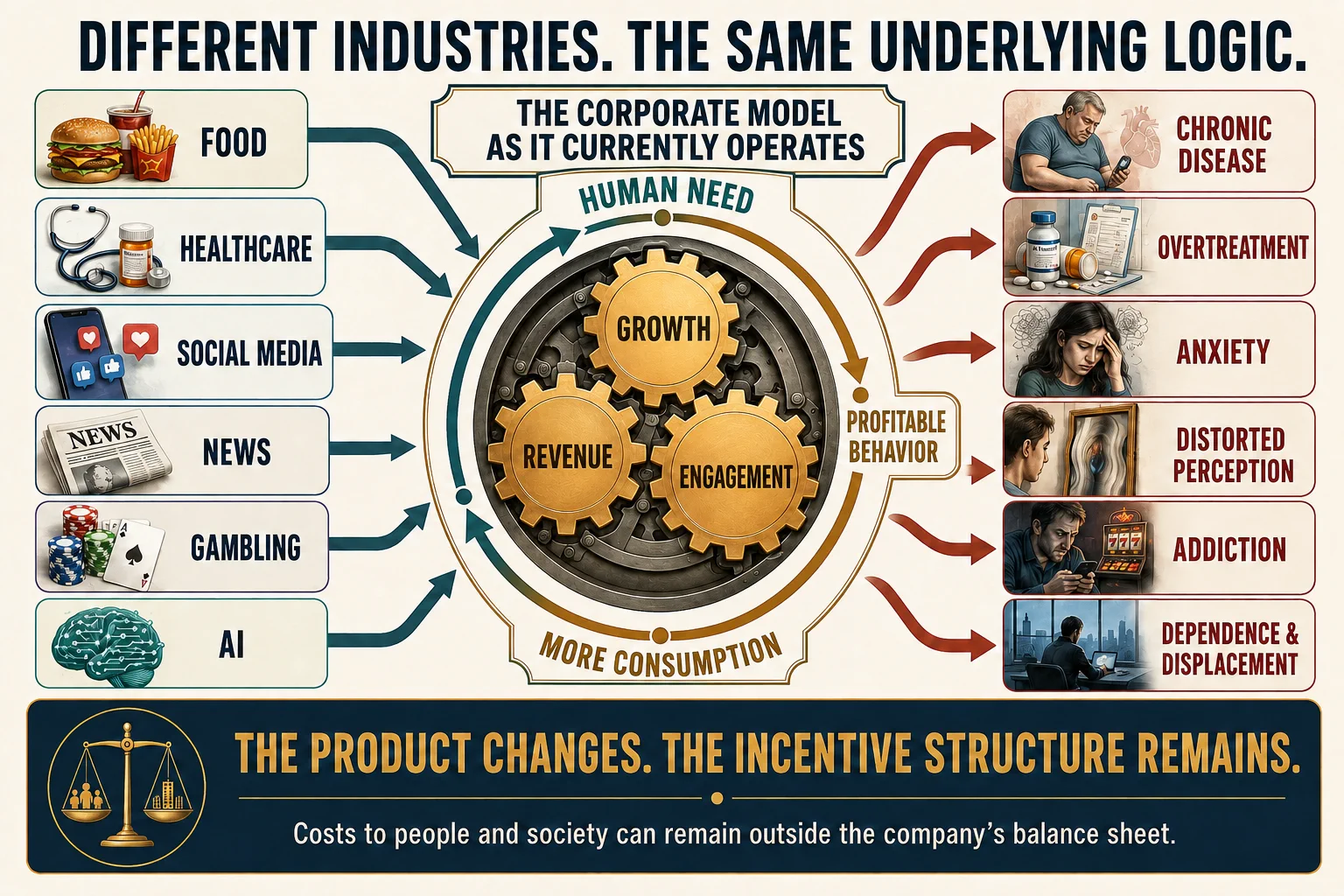
Follow the mechanism
Learn what makes a corporation different from an ordinary business—and how its structure selects the people, decisions and products that deliver financial growth.
Explore how the corporate selection system worksThe question behind the question
That is the investigation.