01
How it began
A deceptively simple question
Diabetes Is Profitable began with a deceptively simple question:
Why has type 2 diabetes become so widespread when its major risk factors have been understood for decades?
The conventional answers—diet, body weight, physical activity, genetics and age—are important. But they mainly explain how the disease develops in individuals.
They do not fully explain why modern societies repeatedly produce environments in which unhealthy dietary patterns become easier, more convenient and more commercially successful.
This project examines that larger question.
02
Who is behind the project?
My name is Tim Barrie.
I am an entrepreneur and former corporate executive—not a physician, epidemiologist or academic researcher.

I spent approximately twenty years working for Intel and subsequently helped lead the North American sales and marketing organization of LANDesk following its separation from Intel. I have also built and operated several smaller businesses.
That experience gave me a practical view of how corporations work from the inside: how growth targets, competition, investor expectations, executive incentives and apparently reasonable business decisions shape organizational behavior.
The central idea behind this website did not begin as a medical theory. It began as a question about systems:
What happens when the behaviors that are economically rewarded do not align with the outcomes society says it wants?
Type 2 diabetes became the case study through which that question was investigated.
03
The structural hypothesis
What this project argues
Corporate incentives help create and continually reinforce a food environment dominated by inexpensive, convenient, heavily marketed and highly consumable products. That environment increases population-level exposure to established risk factors for type 2 diabetes.
Once the disease develops, it generates continuing demand for medication, monitoring, clinical appointments, medical devices and long-term management.
Profitable consumption
The food side of the system can profit from increased consumption.
Profitable treatment
The healthcare side can generate revenue from treating the consequences.
This does not require a conspiracy.
It does not require food companies to want people to become sick, doctors to want patients to remain ill or pharmaceutical companies to have created diabetes.
It requires only that organizations respond rationally to the incentives surrounding them.
The thesis is not that diabetes was planned. It is that the system can reward the conditions that produce it—and then reward managing the result.
04
Claim boundaries
What this project does not claim
This website does not argue that corporations are the only cause of type 2 diabetes.
Human biology, genetics, individual behavior, culture, technology, public policy, income, education, the built environment and access to healthier food all matter.
Nor does the project claim that every corporation, executive, healthcare professional or investor behaves identically.
When millions of individually rational decisions are shaped by the same economic incentives, can they collectively produce a harmful outcome that nobody deliberately intended?
The project follows incentives rather than assuming malicious intent.
05
Personal experience and contradiction
Why I undertook the investigation
This investigation was not prompted only by published research or abstract economic theory.
It was also influenced by personal experience with people living with diabetes.
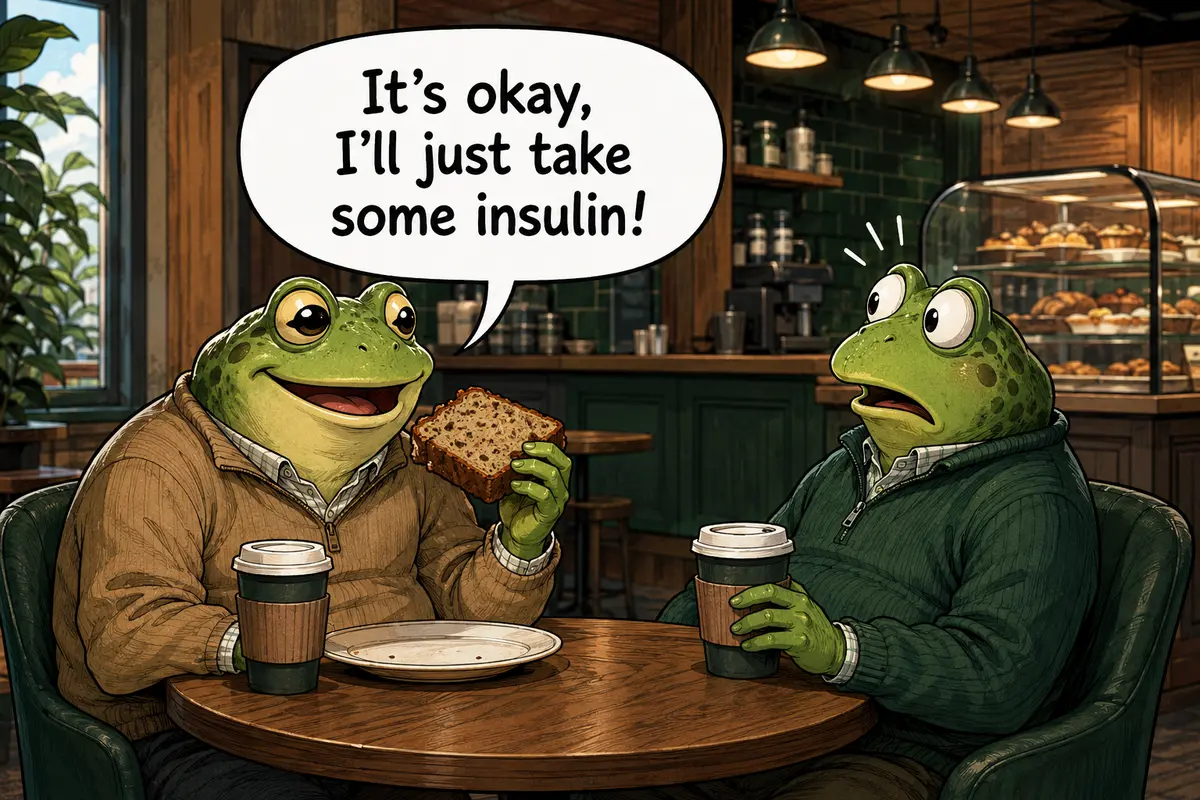
One example was Bill, whose experience is described in the site’s personal anecdotes and developing ideas.
Watching somebody live with diabetes can reveal an uncomfortable contradiction.
From the outside, it may appear obvious what a person “should” do. Once diabetes has developed, surely the logical response is to change the behavior that contributed to it—to eat differently, exercise more consistently and avoid products that make the condition harder to control.
Actual human behavior is rarely that simple.
Knowledge of a health risk does not eliminate appetite, habit, convenience, emotional reward, social influence or the effects of an environment designed to encourage continued consumption. People can understand the consequences and still behave in ways that appear inconsistent with what they know.
Bill’s story helped move the investigation beyond the familiar conclusion that individuals simply make bad decisions.
Why do we expect individuals to resist continuously when much of the environment surrounding them is organized to make resistance difficult?
That contradiction—between what appears medically sensible and what people actually do—became part of the reason for looking further upstream.
I did not begin with a settled conclusion and then search for convenient evidence. The investigation developed through a sequence of questions.
- Why do discussions about type 2 diabetes concentrate so heavily on individual choices?
- What produces the environment in which those choices are made?
- Why are the organizations most capable of shaping that environment financially rewarded for increasing consumption?
- Why does treating chronic disease produce dependable recurring revenue, while preventing disease often produces no equally direct financial return?
If the system is behaving exactly as its incentives encourage it to behave, why would we expect it to produce a different result?
Those questions led from biology to food systems, corporate structures, healthcare economics and eventually to a broader examination of what happens when commercial optimization and human welfare point in different directions.
06
Research, criticism and production
How artificial intelligence was used
Artificial intelligence was used extensively in developing this website.
The project used ChatGPT, Grok and Google Gemini as research and analytical assistants.

Research
Identify and organize relevant evidence, including material that supported or challenged the hypothesis.
Adversarial review
Test causal reasoning and identify contradictions, gaps, counterarguments and possible failures in the logic.
Communication
Explain technical ideas, structure the pages, edit the writing and develop useful visual concepts.
Grok and Gemini were not used merely to repeat or endorse conclusions generated through ChatGPT. They provided additional perspectives and were asked to identify weaknesses, contradictions and problems that another model—or the human directing the investigation—might have missed.
Using several models does not guarantee that the conclusions are correct. AI systems can repeat errors, rely on incomplete information and produce confident answers that are not adequately supported.
Their role was therefore to assist investigation and criticism—not to serve as authorities.
The original structural hypothesis was supplied by a human. AI became most useful after it was given that lens and asked to challenge, research and develop it.
The human supplied the non-obvious question. AI helped investigate and challenge it. Human judgment remained responsible for the conclusions.
The process—including what the AI initially failed to recognize—is documented in the Human–AI Collaboration case study.
07
What kind of statement are you reading?
Evidence, interpretation and uncertainty
This website distinguishes between three different things:

Findings supported directly by published research, government data or other authoritative sources.
Connections that follow from the available evidence but have not necessarily been tested as one complete causal system.
Ideas offered for examination, discussion or further investigation rather than presented as established fact.
The central contribution of Diabetes Is Profitable is primarily a synthesis.
Research already documents the influence of commercial food systems, corporate incentives, ultra-processed-food exposure, diabetes prevalence and expanding markets for treatment.
The project connects those documented elements and asks whether they should be understood as parts of one reinforcing incentive system.
That conclusion is reasoned, but it is not the direct finding of a single experiment.
08
Position inside the system
Independence and financial interests
Diabetes Is Profitable is an independent personal project.
It was not commissioned by a food company, pharmaceutical manufacturer, healthcare provider, political organization or advocacy group.
The website does not sell medical products, treatment programs, supplements or dietary services. It does not currently carry advertising, use affiliate links or receive payment from the industries examined.
Disclosure
I am an investor in the stock market.
That means I am not standing entirely outside the economic system examined here. Like millions of other investors—directly or through pensions, retirement accounts and investment funds—I can benefit when corporations grow and produce financial returns.
That is not a contradiction to conceal. It is part of the point.
The system is not composed simply of corporations on one side and innocent outsiders on the other. Investors, employees, consumers, pension holders and business owners can all participate in—and benefit from—the same structures whose wider consequences we may also question.
I am therefore commenting on a system of which I am a participant.
The purpose of the project is investigation and public discussion—not the promotion of a competing commercial solution.
If any relevant financial interest or source of funding changes materially, that change should be disclosed here.
09
A standing invitation
Corrections and challenges are welcome
A provocative argument deserves scrutiny.
Readers are encouraged to question the evidence, challenge the causal reasoning, identify missing research and propose alternative explanations.
Material errors should be corrected. Important counterarguments should not be hidden merely because they weaken the original thesis.
Report a factual error or citation problemcorrections@diabetesisprofitable.comThe objective is not to defend every sentence permanently. It is to make the investigation more accurate.
10
The principle behind the project
Evidence before certainty.
Systems before blame.
It is easy to explain harmful outcomes by identifying bad people.
It is often more useful to ask what behavior the system rewards—even when the people operating within that system are individually reasonable, ethical and well intentioned.
Diabetes Is Profitable asks readers to consider that possibility.
Not because corporate incentives explain everything.
But because they may explain considerably more than our usual discussions acknowledge.
And if harmful outcomes are being reinforced by rational economic behavior, the most useful question may not be Who should we blame?