Why this page exists.
This website began as an attempt to understand why Type 2 diabetes has become so widespread despite decades of medical progress, public-health advice and individual attempts to prevent it.
The main pages examine evidence and develop a structural argument. This page has a different purpose.
It collects conversations, everyday incidents and thoughts that helped shape the investigation. These are the observations of someone examining the Type 2 diabetes ecosystem from outside it—not the personal experiences of someone living with diabetes.
None of these anecdotes proves the larger thesis. But anecdotes can make an abstract system visible. They can show how the food environment, individual decisions, corporate incentives and medical treatment meet in ordinary life.
The wider thought experiment, Can We Make Harm Unprofitable?, asks whether the same incentive pattern appears beyond diabetes—in news, social media, addiction and healthcare.
These observations are also allowed to develop. I may see an incident one way when it occurs and understand it differently years later. That change in perspective is part of the investigation.
The first observation begins with a slice of banana bread.
A personal observation
“It’s okay—I can just take some insulin.”
A couple of years ago, I was visiting one of my clients in California. I will call him Bill, although that is not his real name.
I was helping Bill market his business by filming some of his construction projects and getting him to talk about the work he had done. After visiting several projects, we stopped at a coffee shop for a mid-afternoon break.
I ordered a coffee and sat down. Bill ordered a coffee and a slice of banana bread.
I didn’t think anything of it.
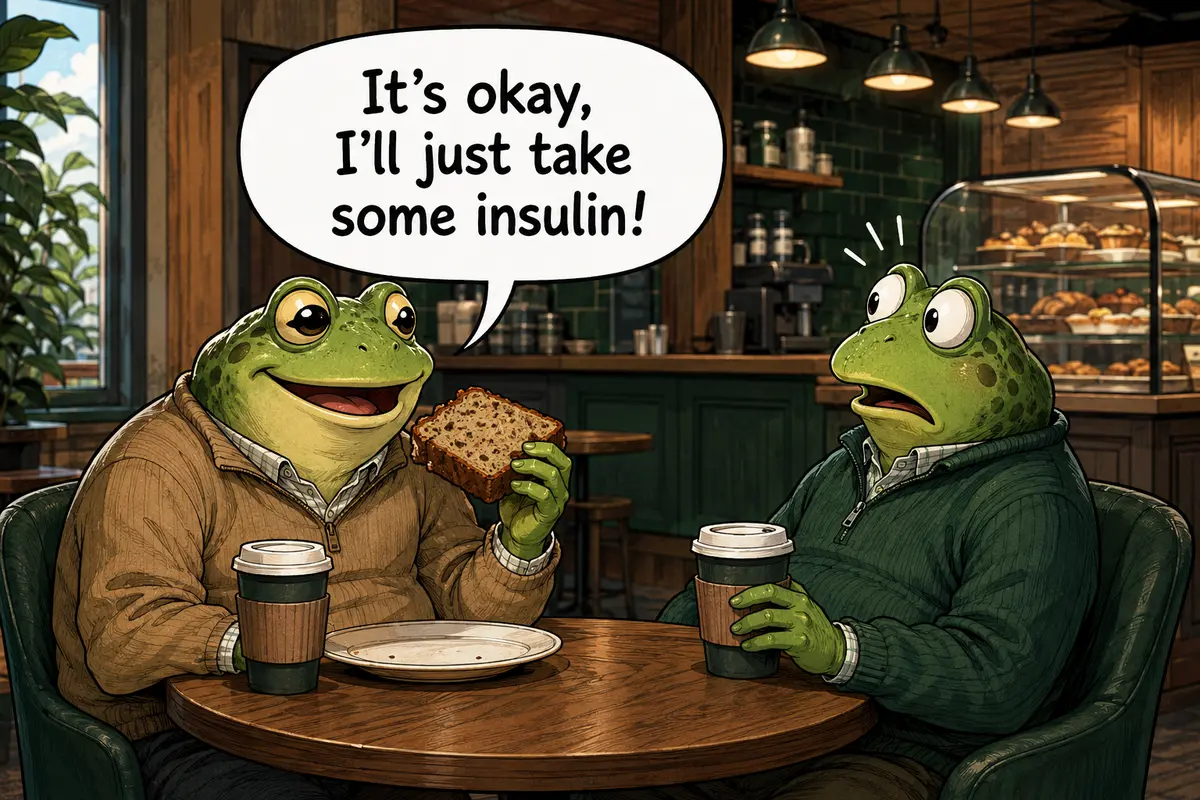
Then Bill began telling me about the difficulties he had experienced over the previous few years because of Type 2 diabetes. He was now taking insulin regularly, and his problems had begun with his foot.
Apparently, he had lost all feeling in the bottom of his foot without realizing it. He developed a huge, deep sore and subsequently needed surgery.
I felt genuinely sorry for him. I was also impressed that, despite everything he had experienced, he was still working and running his business.
Then, suddenly, I looked at the slice of banana bread.
Bill had just spent perhaps half an hour telling me about the damage diabetes had done to his life. Yet he was sitting there eating exactly the sort of highly refined, carbohydrate-heavy food that I believed had contributed to his condition and was making the underlying problem more difficult to control.
Eventually, I said something along the lines of:
“Am I missing something? You’ve just told me about all the problems diabetes has caused you, but you’re sitting there eating banana bread.”
Bill shrugged, laughed and said:
“Oh, it’s okay. I can just take some insulin and it’ll be fine.”
His answer struck me as a form of insanity.
Here was someone who had suffered an extremely serious complication, undergone surgery and reached the point where he required regular insulin. Yet he was continuing to eat the very kinds of food that I believed had contributed to the problem and were making it worse.
My reaction was simple: why not stop eating them?
I believed then—and still believe—that if Bill fully understood what sustained changes in his eating and exercise habits might accomplish, there was a very good probability that he could have mitigated the disease.
That did not mean he was guaranteed to come off insulin or achieve diabetes remission—a sustained return of blood glucose below the diabetes range without glucose-lowering medication (opens glossary in a new tab). I did not know enough about his medical condition to predict that. But I believed there was a strong probability that changing his day-to-day habits could improve his blood-glucose control, reduce his risk of further complications and possibly reduce the amount of medication he required.
Bill appeared to understand that insulin could compensate for what he was eating. I was not convinced that he understood how much influence he might still have over the underlying course of his disease.
Was it simply a lack of willpower?
I replayed that conversation many times over the following years.
Initially, I saw it primarily as a failure of personal responsibility. Bill knew he had diabetes. He knew how serious it had become. Why couldn’t he exercise the willpower to stop eating the banana bread?
I still believe personal responsibility matters. We are not powerless, and it would be a mistake to pretend that our daily decisions have no consequences.
But I have gradually come to see Bill’s decision as part of a much larger problem.
Bill was doing something entirely normal.
We had walked into a coffee shop where sweet baked products were displayed prominently beside the counter. The banana bread was convenient, familiar and pleasurable. Products like it were available almost everywhere Bill went and had probably been part of his diet for most of his life.
The surrounding food environment was encouraging him to eat it. The medical system was giving him a way to manage the immediate consequence.
Eat the banana bread. Take the insulin. Continue with the day.

That is an extraordinarily difficult cycle for some people to break.
People appear to exist across a broad spectrum. Some find highly refined and sweet foods extremely difficult to resist. Others seem much less susceptible.
I consider myself fortunate. Once I became convinced that processed foods, refined carbohydrates, sugar and sugar substitutes were contributing to the problem, I found it relatively easy to stop consuming most of them.
My tastes changed surprisingly quickly. Foods that I had once considered only slightly sweet began to taste insanely sweet. In my experience, sugar seemed to reset my idea of what normal sweetness was: the more accustomed I became to it, the more sweetness I needed to notice it. Once I stopped eating so much of it, that expectation began to reverse.
That was my personal experience. Bill may have experienced the problem very differently.
The system contained the contradiction.
That single coffee-shop visit revealed almost the entire Type 2 diabetes ecosystem.

The food manufacturer benefited from selling the banana bread. The coffee shop benefited from placing it beside the coffee. Investors benefited when the companies sold more products. The healthcare system provided insulin, surgery and continuing treatment after serious illness developed.
Bill received a few minutes of pleasure and convenience. He also carried the physical consequences.
Nobody involved needed to intend to harm him. Every participant could simply respond to the incentives and choices immediately in front of them.
The same commercial system continued to market these foods prominently. The products were everywhere, and many were presented in ways that made them appear healthier than they really were.
The individual was expected to resist an environment designed to make consumption convenient, pleasurable and normal.
Bill was responsible—but he did not create the system.

It would be too easy to absolve Bill of all responsibility. He made the decision to buy and eat the banana bread.
But it would be equally simplistic to pretend that his decision occurred in isolation.
Bill did not formulate the product, determine how it would be marketed or arrange for it to be displayed beside his coffee. He did not create a culture in which highly refined foods are normal at almost every meal and during every break. He did not design a healthcare system that is far better at providing treatment after disease develops than changing the commercial environment that helps produce it.
My first reaction was that Bill was behaving irrationally.
I now think the larger irrationality was the system surrounding him.
We have created an environment that continuously promotes foods that make metabolic health more difficult to maintain. We make those foods pleasurable, inexpensive, convenient and extremely difficult to avoid. We then place most of the responsibility for resisting them on the individual.
When people become ill, we provide increasingly sophisticated treatments while leaving the commercial environment largely unchanged.
The question I was left with was no longer simply:
Why didn’t Bill stop eating the banana bread?
It became:
Why have we designed a system in which eating the banana bread remains the easiest and most normal choice—even after someone has suffered potentially devastating consequences from diabetes?
Evidence-based qualification
What the evidence allows us to conclude.
This story is a personal recollection and interpretation. It does not establish what caused Bill’s diabetes, whether banana bread was typical of his overall diet or what would have happened if he had changed his diet and activity.
The foot problem Bill described is consistent with a recognized diabetes complication. Diabetes-related nerve damage can cause a person to lose feeling in the feet, allowing a sore or injury to become serious before it is noticed. Diabetes can also make wounds harder to heal. That does not allow us to diagnose Bill from an anecdote.
The broader proposition is well supported: nutrition and physical activity are central parts of Type 2 diabetes management. For many people, healthier eating, regular activity and—where relevant—sustained weight loss can improve blood-glucose control and reduce the risk of complications. Some people reduce their medication requirements, and some achieve remission, particularly after substantial and sustained weight loss.
Bill’s individual prospects are unknowable. We do not know the duration or severity of his diabetes, his remaining pancreatic function, his weight, his complete diet, his activity level or his medical history. His use of insulin and history of a serious foot problem make it especially inappropriate to claim that remission was probable for him personally.
It is also medically legitimate for some people who use insulin to match an insulin dose to the carbohydrates they consume. Bill’s comment was therefore not necessarily evidence that he was using insulin incorrectly. What struck me was the larger pattern: treatment could accommodate the immediate choice while leaving the environment and habits surrounding that choice untouched.

People who use insulin can experience dangerous low blood sugar if food, activity or medication changes are not managed appropriately. They should not reduce or discontinue insulin or make major changes likely to alter blood glucose without working with their healthcare team.
Evidence consulted
- National Institute of Diabetes and Digestive and Kidney Diseases (NIDDK) (opens glossary in a new tab): Diabetes and Foot Problems
- NIDDK: Achieving Type 2 Diabetes Remission Through Weight Loss
- Centers for Disease Control and Prevention (CDC) (opens glossary in a new tab): Physical Activity and Diabetes
- American Diabetes Association: Carbs and Diabetes
Observation two
All the frogs are part of the system.
It is comforting to imagine that the system is controlled by a small group of greedy people somewhere else. The truth is less comfortable: most of us participate in it.
We buy the products. We work for the companies. We accept convenience when it is offered. Through shares, pensions and retirement accounts, we expect corporations to keep growing and producing larger returns.
I am part of that system too. I invest in stocks, and I want the value of those investments to rise. When a company reports strong growth, investors usually celebrate. We rarely ask whether every source of that growth is good for the people buying the product or for society as a whole.
This does not mean that every consumer, employee or shareholder approves of harmful outcomes. It means the pressure for continued growth does not originate solely with a few unusually selfish executives. It runs through the entire structure.
Executives are rewarded for growth. Fund managers are judged by returns. Pension holders depend on investment performance. Employees depend on profitable companies for wages. Consumers often choose the cheapest, easiest or most pleasurable product. Politicians hesitate to disrupt employment, investment and economic activity.
Each decision can look reasonable when viewed on its own. Together, the decisions can create an outcome that very few people would consciously choose.
All the frogs are part of the system.
That is not an argument for shared guilt in equal measure. Power and responsibility are not distributed equally. A multinational corporation that designs, markets and distributes a product has more influence than the person encountering it at a checkout counter.
But none of us is standing completely outside the pond.
Recognizing our participation matters because it changes the question. The problem is not simply how to persuade a few bad actors to become better people. The problem is how to alter a system in which millions of individually understandable decisions repeatedly combine to produce harmful results.
The growth imperative is reinforced by the expectations of ordinary investors and institutions, not only corporate executives.
Owning shares does not make every investor personally responsible for every corporate action, and profitable growth does not inherently require harm.
Observation three
The system itself creates sickness.
The strongest version of the argument is also the most uncomfortable: the system itself creates sickness.
I do not mean that a group of people sat in a room and deliberately designed Type 2 diabetes. I do not mean that food companies want particular customers to become ill or that doctors want their patients to remain sick.
I mean that the system predictably creates conditions in which more sickness develops than would develop under a differently designed system.
Public companies are expected to grow. A food company can grow by reaching more people, persuading existing customers to consume more often, reducing production costs, increasing margins and developing products people find difficult to resist.
The system therefore rewards many of the characteristics that can make a product commercially successful: intense flavor, convenience, long shelf life, low-cost ingredients, constant availability, habitual consumption and relentless marketing.
The harms are often delayed, dispersed and difficult to attribute to one product or company. The revenue is immediate and measurable.
Once illness develops, another set of economically useful activities begins: consultations, tests, prescriptions, devices, procedures, hospital care and long-term disease management. These services are often necessary, valuable and provided by people sincerely trying to help. But economically, the system is generally better organized to generate revenue from treatment than to reward the prevention of illness before a patient appears.
This is not a conspiracy. It is an emergent result of the incentives.
Nobody has to choose the final outcome. The system can produce it automatically.

When the benefits of selling more are immediate but the health costs are delayed and borne by individuals, families, employers, insurers and taxpayers, preventable sickness can become a predictable by-product of normal economic behavior.
Type 2 diabetes has multiple causes and cannot be attributed entirely to corporations or the food environment. Markets also produce valuable foods, medicines, technologies and services that improve health and extend lives.
The constructive question
What would a better system reward?
If the system helps produce the problem, telling individuals to exercise more willpower cannot be the whole solution.
Personal responsibility still matters. Education still matters. Better medical advice, earlier diagnosis and effective treatment still matter. But we should also ask how to make the healthier decision the easier and more normal decision.
The goal is not to eliminate profitable companies or assume that government can design every choice correctly. Nor is it to ban every product that can be harmful when consumed excessively.
The goal is to align profit more closely with human wellbeing, so that companies can prosper by helping people remain healthy—not prosper despite, or partly because of, widespread preventable illness.
A better-designed system might:
- Make the long-term health consequences of products more visible and difficult to obscure with misleading claims.
- Reward companies for producing genuinely healthier products people want to buy, rather than relying mainly on restriction and punishment.
- Reduce the commercial advantage of making unhealthy products ubiquitous, inexpensive and difficult to resist.
- Reward healthcare organizations more strongly for prevention and durable improvements in health, not only for delivering treatment after disease develops.
- Measure corporate success over longer periods and account more honestly for costs transferred to families, employers, insurers and taxpayers.
- Give investors practical ways to distinguish growth that creates durable value from growth that depends on ever-greater harmful consumption.
- Test changes carefully, measure real outcomes and revise policies when they create unintended consequences.
These are starting points, not finished solutions.
The question is not whether we can design a perfect system. We cannot. The useful question is whether we can tweak the existing system so that fewer individually rational decisions accumulate into a collectively irrational result.
A living collection
Future observations.
This page is intended to grow. Future entries may examine:
- Why products marketed as “healthy” can still be dominated by refined carbohydrates or added sweeteners.
- How convenience changes what people eat even when they understand the health consequences.
- Why food that once tasted mildly sweet can taste overwhelmingly sweet after reducing sugar.
- The contradiction between wanting our investments to grow and objecting to the methods that sometimes produce that growth.
- The difference between treating a disease effectively and changing the conditions that make the disease common.
- Encounters with people who know a food may be harming them but develop perfectly understandable reasons to keep eating it.
An anecdote is not proof. But it can be the moment when a question becomes impossible to ignore.
And sometimes a system is easiest to see in something as ordinary as a man, a coffee and a slice of banana bread.