The Bigger Picture: Can We Make Harm Unprofitable?
A thought experiment about capitalism, corporate structures, human behavior—and unintended consequences
This website began with a question about type 2 diabetes.
That investigation led us from biology to food, from food to corporate incentives, and from corporate incentives to healthcare economics.
But eventually another question appeared.
What if the pattern we were looking at wasn't really about diabetes?
What if diabetes was simply one particularly visible example of something much larger?
This is a thought experiment about that possibility.
It is not an argument against corporations.
It is not an argument against capitalism.
And it is certainly not an argument that people running corporations deliberately set out to harm anybody.
The question is more interesting than that.
Could perfectly rational decisions made by perfectly reasonable people produce harmful outcomes because the economic system rewards the behaviors that produce them?
And if so:
Can we make harm unprofitable?
Start with diabetes
The central argument explored elsewhere on this website is that the biological mechanisms behind type 2 diabetes are well understood—but biology alone may not tell us very much about why so many people are developing the disease.
Human beings did not suddenly change biologically.
Our environment did.
Food became extraordinarily available, inexpensive, convenient and increasingly optimized for consumption.
None of this requires anyone in the food industry to want people to develop diabetes.
Quite the opposite.
Imagine a perfectly decent executive running a food company.
The company competes with other food companies.
It needs customers.
It needs revenue.
Its investors expect growth.
If people buy more of its products, that's generally good for the company.
If a competitor discovers a product that consumers find more appealing, our hypothetical executive needs to respond.
The company that gets progressively better at selling food tends to outperform the company that gets progressively worse at it.
That's capitalism doing something it does remarkably well.
It optimizes.
The interesting question is what happens when the thing being optimized isn't perfectly aligned with long-term human welfare.
Then we noticed something
Once we started looking at diabetes this way, the same basic pattern seemed to appear elsewhere.
Not identically.
Not necessarily for the same reasons.
And these examples do not prove that a single mechanism explains all of them.
But the similarities are striking enough to justify a thought experiment.
News: when fear captures attention
Imagine a person walking alone through a park.
How dangerous is that person's environment?
And how does that person develop their perception of that danger?
Human beings naturally pay attention to threatening information. There are perfectly understandable evolutionary reasons why noticing possible danger might have been useful.
There's nothing inherently wrong with that characteristic.
The interesting part is what happens when attention becomes commercially valuable.
A news organization needs viewers, readers, listeners or clicks.
And we now have experimental evidence that negative language can attract more of them.
A large study published in Nature Human Behaviour examined more than 105,000 headline variations generating approximately 370 million impressions. For an average-length headline, adding one negative word increased the click-through rate by about 2.3%.¹
That is not evidence that journalists are deliberately trying to frighten people.
It demonstrates something more relevant to this thought experiment:
Negativity can have measurable economic value in an attention-based system.
Now add another peculiar feature of modern mass communication.
In a country containing hundreds of millions of people, extremely unusual things happen every day.
Imagine an event that has only a one-in-a-million chance of happening to any particular person during a year.
Across 350 million people, we would still expect roughly 350 instances.
Potentially almost one horrifying story every day.
Every story could be completely true.
Yet consuming a steady stream of those stories could create a very different impression from experiencing the underlying statistical reality.
The distortion doesn't require misinformation.
It can arise through selection.
Crime provides an interesting real-world illustration.
FBI data analyzed by Pew Research Center show that the U.S. violent-crime rate fell 49% between 1993 and 2022. Yet in 23 of 27 Gallup surveys conducted since 1993, at least 60% of Americans said crime nationally had increased from the previous year.²
That does not prove that news coverage caused the discrepancy.
Many things influence people's perception of danger.
But the discrepancy makes the systems question worth asking:
Does the economic reward for capturing our attention necessarily produce an accurate perception of the risks around us?
Sometimes those objectives will align.
Sometimes perhaps they won't.

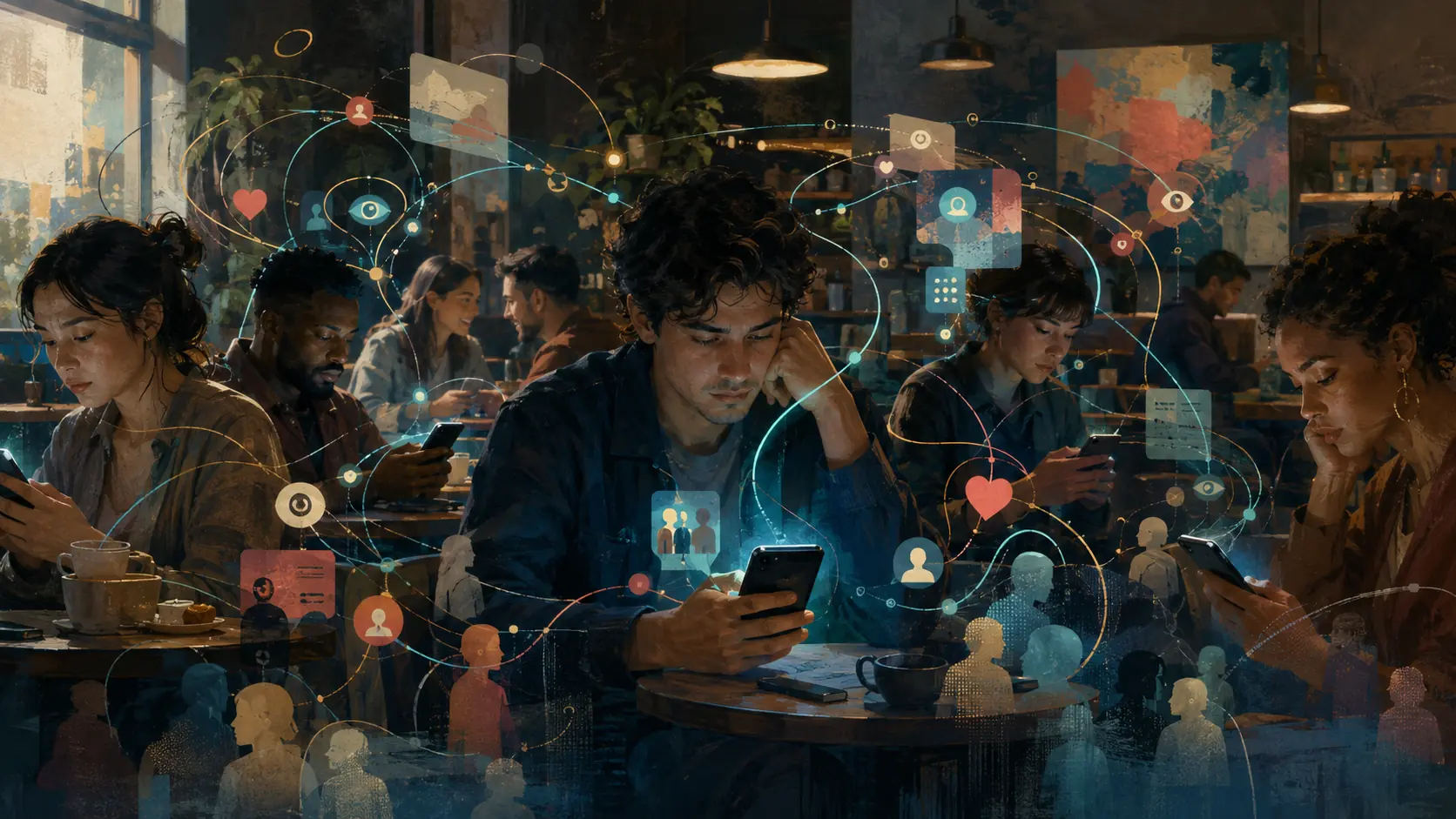
Social media: when engagement becomes the objective
Now consider social media.
Human beings want social connection.
We care what other people think about us.
We compare ourselves with others.
We seek approval.
We respond to novelty.
Again, none of those characteristics was invented by a technology company.
They are part of being human.
But now introduce a business whose economic success depends partly upon keeping people engaged.
Every additional minute of attention can have economic value.
So systems can optimize.
Which notification brings someone back?
Which content keeps them scrolling?
Which recommendation produces another click?
Which material generates another interaction?
Modern algorithmic systems can measure these behaviors at enormous scale. They do not necessarily need a theory of human psychology to discover which choices increase engagement.
And there is legitimate reason to be concerned about whether maximizing engagement and maximizing wellbeing always point in the same direction.
The U.S. Surgeon General's advisory on social media and youth mental health concluded that we cannot currently say social media is sufficiently safe for children and adolescents. It also reported evidence that young people spending more than three hours per day on social media face roughly twice the risk of certain mental-health problems, while explicitly recognizing that social media can also provide important benefits.³
That distinction matters.
This isn't an argument that social media is bad.
It isn't even proof that social media causes every harm associated with heavy use.
It is an observation about alignment:
Maximum engagement and maximum human wellbeing are not necessarily the same objective.
And if the economic system rewards one of those far more directly than the other, we should probably pay attention.
Addiction: when the best customer may be the most vulnerable customer
Consider gambling.
Millions of people can visit a casino, spend some money, enjoy themselves and leave.
There is nothing inherently mysterious about that.
But some people respond very differently.
Some human beings are particularly susceptible to compulsive behavior and addiction.
Now the economic question becomes uncomfortable.
What happens when the customers who have the greatest difficulty regulating their consumption can also become some of the most economically valuable customers?
This isn't merely hypothetical.
The World Health Organization reports estimates suggesting that people gambling at harmful levels generate around 60% of gambling losses—that is, gambling revenue. A systematic review of gambling consumption and harm likewise found substantial concentration of spending among people experiencing gambling problems, although the extent varies significantly by type of gambling.⁴
Research into electronic gaming machines adds another interesting dimension. A systematic review of experimental research found that design features such as "near misses" can motivate continued play.⁵
The point is not that gambling businesses are uniquely evil.
Nor is the argument that gambling, alcohol or other potentially addictive activities should necessarily disappear.
The underlying human susceptibility is not something corporations invented.
The structural question is narrower:
What happens when an economic system can become more profitable as vulnerable customers consume more?
The same question can potentially be asked about alcohol, nicotine and other products or behaviors capable of becoming addictive.
Again, we don't need to establish malicious intent.
The incentive conflict exists whether anyone intended to create it or not.
Healthcare: when treating the problem creates economic activity
Healthcare is different from the previous examples, but it raises another version of the same puzzle.
We want doctors.
We want hospitals.
We want medicines.
We want researchers developing better treatments.
Modern medicine has produced extraordinary improvements in human life.
But healthcare also creates economic activity when people become sick.
Tests generate revenue.
Procedures generate revenue.
Medications generate revenue.
Ongoing treatment generates revenue.
Preventing someone from becoming sick in the first place can be enormously valuable to that person and to society.
But where does the economic reward for that prevention appear?
This isn't merely a philosophical concern.
For years, healthcare policymakers themselves have explicitly discussed the problem of payment systems that reward the volume of services rather than the value of outcomes.
The Centers for Medicare & Medicaid Services has described traditional fee-for-service arrangements as rewarding providers according to how many patients they see, tests they perform or procedures they deliver. CMS has been developing value-based payment systems specifically to better align financial incentives with quality, outcomes and population health.⁶
That is fascinating in the context of this thought experiment because it demonstrates something important:
Incentive structures can be redesigned.
The problem is not necessarily healthcare companies or healthcare professionals.
The problem may be that different payment structures reward different behaviors.
And so another alignment question emerges:
Can keeping someone healthy become at least as economically compelling as treating them after they become sick?
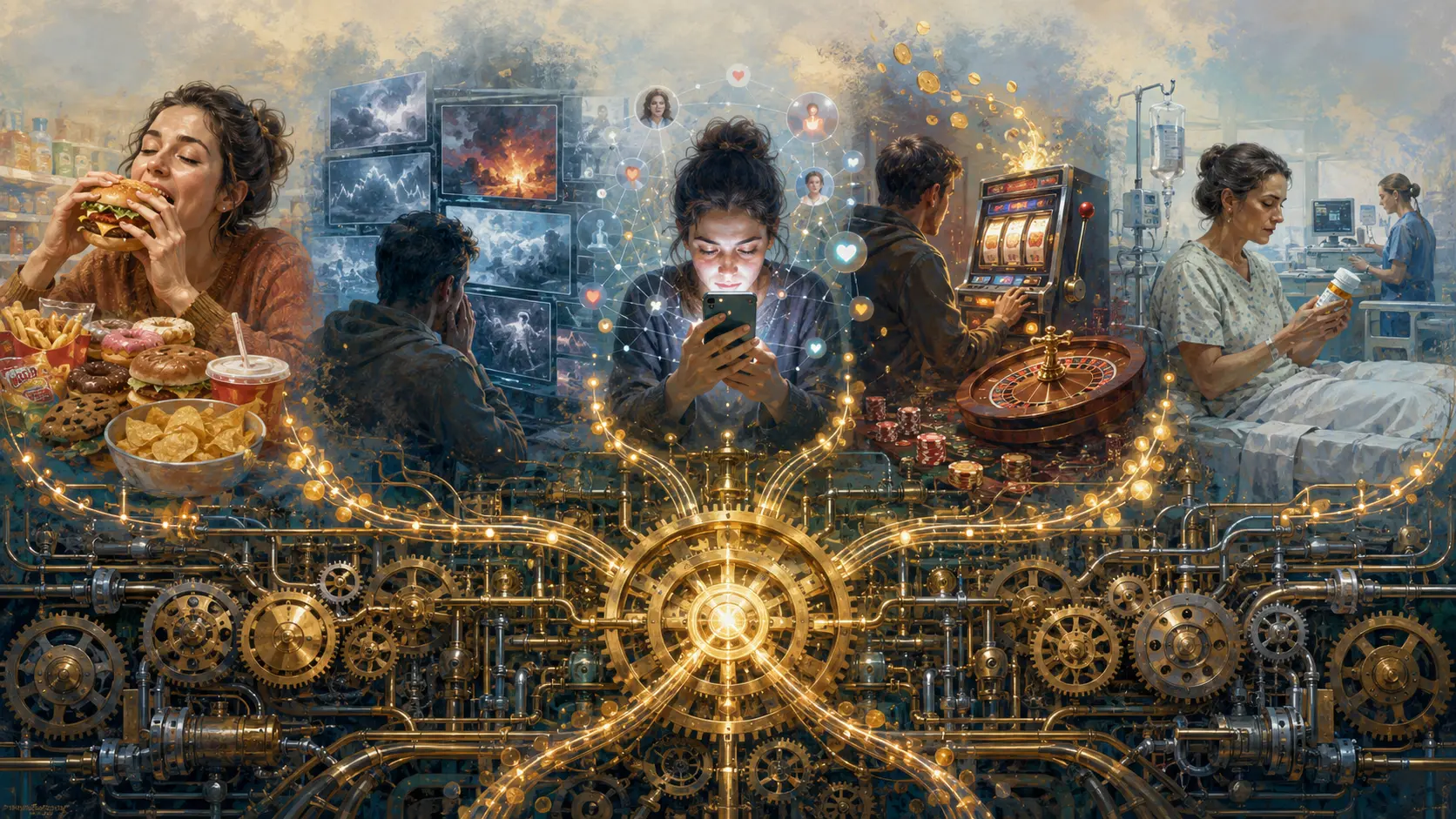
Five different domains. One curious pattern.
We now have examples involving:
Food.
Healthcare.
News.
Social media.
Addiction.
These are very different parts of society.
Yet something similar seems to keep appearing.
A normal human characteristic or vulnerability exists.
Appetite.
Attention to danger.
Need for social approval.
Susceptibility to reward and addiction.
Illness and biological vulnerability.
A commercial system interacts with that characteristic.
Competition rewards organizations that become progressively better at producing an economically valuable outcome.
And sometimes the economically valuable outcome and the long-term interests of the human being aren't quite the same thing.
That doesn't prove a grand theory.
But it seems sufficient to justify asking whether there is one.
Imagine you're an alien
Many years ago, I encountered a science-fiction story whose title and author I can no longer remember.
I barely remember the story.
But one idea from it stayed with me for decades.
Aliens arrived on Earth and observed our civilization.
They concluded that humans weren't actually the dominant intelligent entities on the planet.
Corporations were.
I don't remember precisely how the author developed the idea, and I don't want to pretend that I do.
But the concept is fascinating as a thought experiment.
Look at a corporation from sufficiently far away.
It acquires resources.
It processes information.
It competes with other corporations.
It adapts.
It grows.
It develops mechanisms for protecting itself.
It retains institutional memory.
Its individual human components come and go while the organization itself persists.
Executives leave.
Employees retire.
Shareholders sell.
Generations die.
The corporation continues.
Corporations aren't literally biological organisms, of course.
Nor does this analogy require us to imagine that corporations are conscious.
But viewed as systems, they behave in some surprisingly organism-like ways.
And perhaps most importantly:
They undergo something resembling selection.
Organizations that succeed tend to survive.
Organizations that fail tend to disappear.
Successful strategies are copied.
Unsuccessful strategies are abandoned.
Which raises an intriguing possibility.
Maybe asking corporations to behave better misses part of the problem.
Perhaps we should be asking:
What behaviors are we selecting for?
Capitalism may be working exactly as designed
This is where it would be very easy to misunderstand the argument.
This isn't an argument against capitalism.
Quite the opposite.
Capitalism has arguably been the most extraordinarily productive economic system humans have yet developed.
It harnesses competition.
It rewards innovation.
It discovers efficiencies.
It reallocates resources.
And above all:
It optimizes.
That is an extraordinary capability.
But powerful optimization systems have an interesting characteristic.
You need to be very careful about what you ask them to optimize.
If increased consumption produces greater economic success, businesses will become extraordinarily good at increasing consumption.
If attention produces greater economic success, businesses will become extraordinarily good at capturing attention.
If engagement produces greater economic success, businesses will become extraordinarily good at generating engagement.
If treatment is rewarded more directly than prevention, enormous resources may naturally accumulate around treatment.
None of this requires bad people.
It requires only a powerful optimization mechanism responding rationally to the incentives we've given it.
Perhaps capitalism's potential weakness, therefore, isn't that it doesn't work.
It's that it works extremely well.
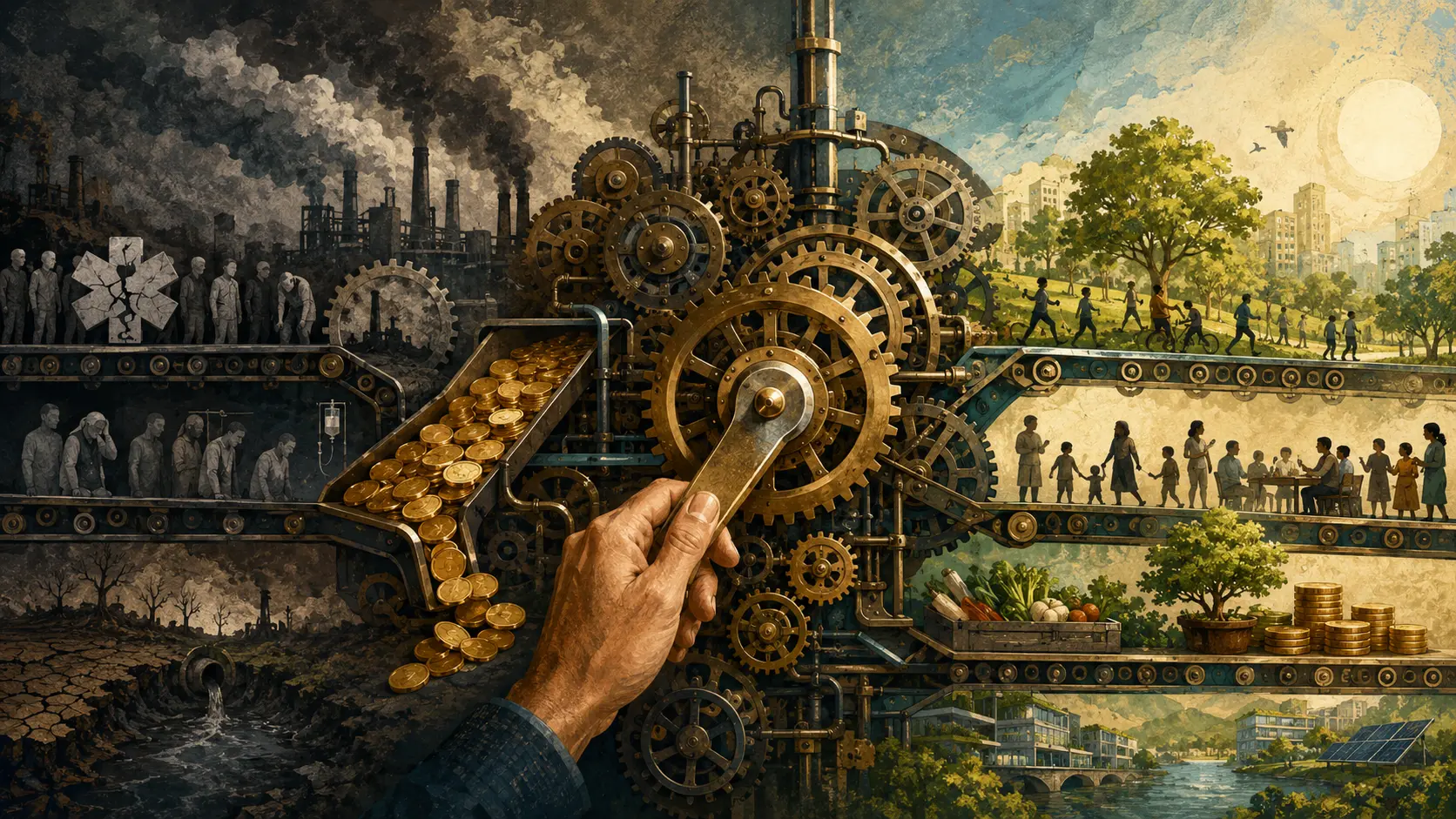
Don't fight the optimizer. Change what winning means.
Suppose we discover that some corporate behavior produces substantial social harm.
One response is to ask corporations to behave differently.
Be more responsible.
Put society first.
Accept lower profits.
Sometimes that may work.
But there is an obvious structural problem.
If one corporation voluntarily accepts a significant competitive disadvantage and another doesn't, which one does the economic environment reward?
Eventually we are back to selection.
So perhaps the more durable solution isn't asking corporations to stop behaving economically.
Perhaps it is changing the economic environment in which they compete.
Make the socially desirable behavior economically advantageous.
Make harmful behavior economically disadvantageous.
Then unleash capitalism on the problem.
Let companies compete.
Let entrepreneurs innovate.
Let investors search for opportunities.
Let businesses relentlessly optimize.
But change what constitutes winning.
Healthcare already gives us a limited real-world example of the principle. Value-based payment programs attempt to reward quality and outcomes rather than simply rewarding greater quantities of medical services. Whether particular programs succeed is an empirical question, but the underlying idea is exactly the one we're considering:
change the incentive and allow rational economic behavior to respond.
Can we make harm unprofitable?
That may be the bigger question hiding behind our investigation of diabetes.
Not:
How do we stop corporations making profits?
Not:
How do we persuade executives to become better people?
Not even:
How do we make corporations responsible for human welfare?
Something simpler.
Can we make harm unprofitable?
Can we design economic structures so that producing significant harm ceases to be a competitive advantage?
Can we arrange the incentives so that the economically rational decision and the socially desirable decision increasingly point in the same direction?
Can we harness capitalism's extraordinary ability to optimize rather than fight against it?
We don't pretend to have the answer.
That's why this is a thought experiment.
And we deliberately haven't tried to produce a catalogue of every industry or social problem to which the idea might apply.
That would rather defeat the purpose.
If the pattern is real, perhaps you will recognize it somewhere we haven't mentioned.
Perhaps you won't.
Perhaps there are important reasons why these examples aren't as similar as they first appear.
That's worth thinking about too.
Because this isn't intended to tell you what to think.
It is an invitation to look at familiar problems from a slightly different direction.
Instead of asking:
Who is behaving badly?
Perhaps sometimes we should ask:
What behavior is the system rewarding?
And then one final question:
Can we make harm unprofitable?
Evidence and further reading
1. Negative news and attention. Robertson CE, Pröllochs N, Schwarzenegger K, et al. Negativity drives online news consumption. Nature Human Behaviour. 2023. Large-scale randomized headline experiments found that negative language increased click-through rates.
2. Crime and perception. Pew Research Center analyses of FBI crime statistics and public-opinion data. U.S. violent crime declined dramatically from its early-1990s levels even as surveys frequently found Americans believing crime was increasing nationally.
3. Social media and youth mental health. U.S. Surgeon General. Social Media and Youth Mental Health. The advisory summarizes evidence of both benefits and potential harms and concludes that social media cannot currently be considered sufficiently safe for children and adolescents.
4. Gambling harm and revenue concentration. World Health Organization, Gambling fact sheet; and systematic research examining concentration of gambling expenditure among people experiencing gambling problems.
5. Gambling-machine design. Barton KR et al. The Effect of Losses Disguised as Wins and Near Misses in Electronic Gaming Machines: A Systematic Review. Journal of Gambling Studies. 2017.
6. Healthcare incentives. Centers for Medicare & Medicaid Services materials on fee-for-service and value-based payment programs, including CMS's explicit distinction between paying for volume and paying for quality/value.